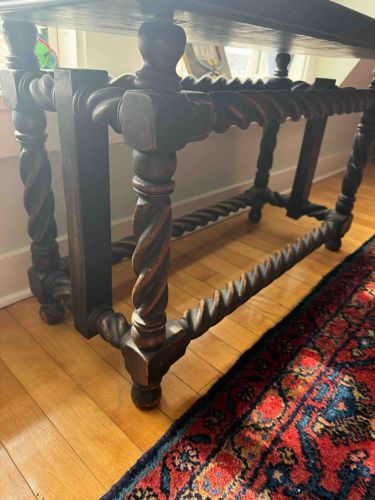
17th Century Style Oak Barley Twist Library Table
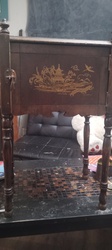
This is a rectangular side or library table featuring heavy construction characteristic of 17th-century European furniture, specifically the William and Mary or Jacobean periods. The piece is crafted from a dark-stained wood, likely solid oak, showing a deep chocolate brown patina. It features four primary legs and a central supporting trestle structure, all of which are intricately carved in an open barley twist (solomonic) design. These twists are separated by square-cut joinery blocks, indicating robust mortise and tenon construction. Horizontal stretchers also utilize the barley twist motif, connecting the legs near the base to provide structural stability and visual weight. The table exhibits significant age-appropriate wear, including softening of the carved edges, minor scuffs on the lower feet, and a rich, uneven surface patina that suggests decades of polishing. The top appears to have a thick, flat edge, resting directly on the turned capitals of the legs. While the user states it is from the 1600s, the precision of the spiral carving and the specific luster of the finish could also suggest a high-quality 19th-century 'Jacobean Revival' piece, though the heavy proportions and wear patterns are consistent with early continental styles. Notable craftsmanship is seen in the symmetry of the hand-turned spirals and the integrity of the joints.
AI-Generated Appraisal Disclaimer
Estimated Value
$1,200 - $1,800 USD
Basic Information
Category
Antique Furniture
Appraised On
March 15, 2026
Estimated Value
$1,200 - $1,800 USD
Additional Details Provided By Owner
User Provided Information
Table from the 1600s
Item Description
This is a rectangular side or library table featuring heavy construction characteristic of 17th-century European furniture, specifically the William and Mary or Jacobean periods. The piece is crafted from a dark-stained wood, likely solid oak, showing a deep chocolate brown patina. It features four primary legs and a central supporting trestle structure, all of which are intricately carved in an open barley twist (solomonic) design. These twists are separated by square-cut joinery blocks, indicating robust mortise and tenon construction. Horizontal stretchers also utilize the barley twist motif, connecting the legs near the base to provide structural stability and visual weight. The table exhibits significant age-appropriate wear, including softening of the carved edges, minor scuffs on the lower feet, and a rich, uneven surface patina that suggests decades of polishing. The top appears to have a thick, flat edge, resting directly on the turned capitals of the legs. While the user states it is from the 1600s, the precision of the spiral carving and the specific luster of the finish could also suggest a high-quality 19th-century 'Jacobean Revival' piece, though the heavy proportions and wear patterns are consistent with early continental styles. Notable craftsmanship is seen in the symmetry of the hand-turned spirals and the integrity of the joints.
Related Tags
Get Your Items Appraised
Instant estimates of your treasures with AI-powered instant appraisals