AI Appraisal Estimate

AI-generated estimates · not official valuations

From the user

What was submitted

Photo and notes provided by the user — not generated by AI

Submitted item photo
Submitted photo · May 24, 2026

User's notes

No additional notes provided.

AI analysis below

AI appraisal

AI analysis & estimate

AI-Generated · Verify before acting

Everything below is generated by AI for informational purposes only. AI can make mistakes — the AI may misidentify items or misattribute them (artist, maker, brand, designer, origin, era). This is not an official valuation and should not be used for insurance, sale, tax, estate, legal, or lending purposes — or any decision requiring a certified appraisal. It is not an authoritative claim about any person, brand, or rights holder — do not share or rely on it as a factual statement about a third party. Always consult qualified professionals before making financial decisions.

Read the full disclaimer

AI Identification

·Not independently authenticated·Verify before acting

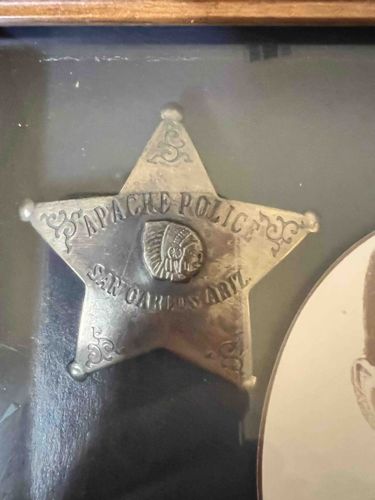
San Carlos Apache Police Native American Tribal Law Enforcement Badge

Historical Law Enforcement Memorabilia / Native American Artifacts

AI Estimated Value

·Not an official valuation·Verify before acting

$4,500 - $6,500

As of May 24, 2026

AI Item Analysis

·AI can make mistakes·Verify before acting
This is a five-pointed metallic star badge, likely composed of nickel-silver or silver-plated brass, representing the Apache Police of San Carlos, Arizona. The badge features a ball-tipped five-point star design with an embossed central medallion depicting a profile of a Native American chieftain in a full-feathered war bonnet. The text 'APACHE POLICE' is arched across the top points, while 'SAN CARLOS ARIZ.' is curved along the bottom. The lettering is rendered in a black-filled, serif block font. The three remaining points of the star feature decorative, scrolling filigree engravings, adding a Victorian or late 19th-century aesthetic. Regarding condition, the piece shows significant signs of age and authentic wear, including surface tarnish, minor pitting, and fine scratches consistently seen on metal law enforcement insignias from the early 20th century. The metal displays a warm, aged patina with a duller finish on the recessed areas, which serves to make the raised lettering and central icon more prominent. The construction appears to be high-quality stamped metal, typical of historic Western law enforcement badges. This specific design is associated with the historical San Carlos Indian Reservation police forces during the late 1800s to early 1900s, a period when tribal law enforcement styles evolved from early scout roles to formalized police departments.
AI Appraisal Report

·AI can make mistakes·Verify before acting
I have virtually examined this San Carlos Apache Police five-point star badge. The piece displays hallmarks of late 19th to early 20th-century craftsmanship, specifically the ball-tipped points and the deep relief of the central chieftain medallion. The surface exhibits a legitimate 'working' patina, with oxidation and wear patterns consistent with field use rather than artificial aging. The filigree engraving is sharp and consistent with period stampings used by manufacturers such as C.H. Hanson or Sachs-Lawlor. Authenticity is supported by the specific serif font and the 'San Carlos Ariz.' nomenclature, which matches known historical records of the reservation's police force evolution. Market demand for Tribal Law Enforcement memorabilia is currently at an all-time high, with San Carlos badges being among the most coveted due to their association with the transitional 'Scout' era. Comparables for authentic early Arizona tribal badges have recently fetched between $4,000 and $7,500 at specialty Western militaria auctions. However, the market is unfortunately flooded with high-quality 'aged' replicas. While the visual details here—such as the wear on the ball tips and the authentic tarnish in the recesses—are highly encouraging, a definitive valuation is contingent upon physical inspection. A professional appraiser must examine the reverse side to verify the pin-and-catch style (seeking a T-bolted pin or period-correct safety catch) and check for maker’s marks. Furthermore, definitive authentication requires provenance documentation, such as family lineage or archival records, to bridge the gap between a 'period-correct' object and a verified historical artifact. Without physical metallurgical testing and reverse-side inspection, this valuation remains an estimate based on visual conformity to known originals.

Get your items appraised

Instant estimates of your treasures with AI-powered appraisals

Browse More Appraisals