Vintage Floral Dinner Plate with Scalloped Gilt Edge
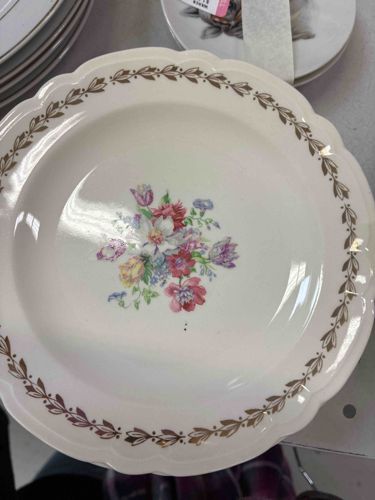
This is a vintage ceramic dinner plate, likely earthenware or semi-vitreous porcelain, featuring a creamy off-white ground. The plate is circular with a distinctive scalloped rim, typical of mid-20th-century American or English dinnerware. The rim is decorated with a continuous laurel-style branch or leaf border executed in a gold/bronze metallic finish. Its central well features a polychrome floral transfer-ware decal depicting a bouquet of pink roses, purple tulips, yellow wildflowers, and blue blossoms. Physically, the glaze presents a high-gloss finish, though light surface scratches and utensil marks are visible under the direct light source, consistent with regular household use. There is a small dark spot or occlusion located near the bottom of the central floral motif, which appears to be a factory-level firing defect or an over-glaze inclusion. No major chips or structural cracks are immediately apparent on the face, though the edges show slight wear to the gilding. Based on the style, this piece likely dates from the 1940s to the 1960s, a period when manufacturers like Homer Laughlin or Edwin M. Knowles produced similar patterns for the mass market. The craftsmanship is indicative of high-quality mass production, intended for daily durability combined with traditional aesthetic appeal.
AI-Generated Appraisal Disclaimer
Estimated Value
$15.00 - $25.00
Basic Information
Category
Antique/Vintage Tableware
Appraised On
March 26, 2026
Estimated Value
$15.00 - $25.00
Item Description
This is a vintage ceramic dinner plate, likely earthenware or semi-vitreous porcelain, featuring a creamy off-white ground. The plate is circular with a distinctive scalloped rim, typical of mid-20th-century American or English dinnerware. The rim is decorated with a continuous laurel-style branch or leaf border executed in a gold/bronze metallic finish. Its central well features a polychrome floral transfer-ware decal depicting a bouquet of pink roses, purple tulips, yellow wildflowers, and blue blossoms. Physically, the glaze presents a high-gloss finish, though light surface scratches and utensil marks are visible under the direct light source, consistent with regular household use. There is a small dark spot or occlusion located near the bottom of the central floral motif, which appears to be a factory-level firing defect or an over-glaze inclusion. No major chips or structural cracks are immediately apparent on the face, though the edges show slight wear to the gilding. Based on the style, this piece likely dates from the 1940s to the 1960s, a period when manufacturers like Homer Laughlin or Edwin M. Knowles produced similar patterns for the mass market. The craftsmanship is indicative of high-quality mass production, intended for daily durability combined with traditional aesthetic appeal.
Related Tags
Get Your Items Appraised
Instant estimates of your treasures with AI-powered instant appraisals