These notes were written by the person who submitted this item. Appraiser.AI has not verified them, and the AI's identification and estimate may rely on them.
AI Estimated Value
Not an official valuation
$400-700
AI estimate as of August 17, 2025 · verify with a professional before acting
AI-Generated · Verify before acting
Everything on this page is generated by AI for informational purposes only. AI can make mistakes — the AI may misidentify items or misattribute them (artist, maker, brand, designer, origin, era). This is not an official valuation and should not be used for insurance, sale, tax, estate, legal, or lending purposes — or any decision requiring a certified appraisal. It is not an authoritative claim about any person, brand, or rights holder — do not share or rely on it as a factual statement about a third party. Always consult qualified professionals before making financial decisions.
This analysis also relies on unverified notes provided by the user, which may be incomplete or inaccurate and could affect the result.
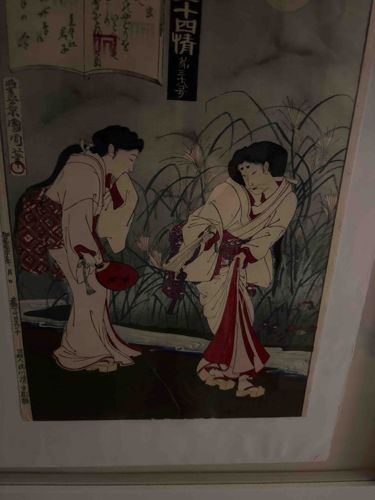
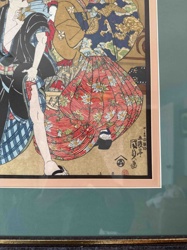
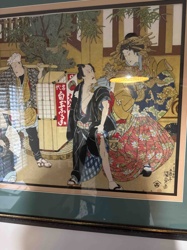
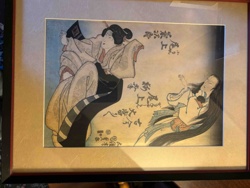
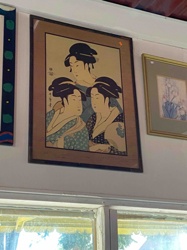
This item is a Japanese woodblock print, likely an ukiyo-e, depicting two female figures in traditional Japanese attire. The print appears to be hand-colored or created with multiple carved blocks to apply different colors. The primary colors visible are various shades of white, red, and dark tones for the background and hair. One figure, on the left, is seen holding a red fan and is dressed in a white kimono with a dark red patterned obi. Her posture suggests a moment of contemplation or interaction. The second figure, on the right, is reaching down towards what appears to be water or low-lying foliage, also dressed in a white kimono with red accents. The background features tall, slender plants, possibly pampas grass, under a full or crescent moon, suggesting a night scene outdoors. There are visible Japanese characters and script in the upper left quadrant, indicative of title, artist signature, or publisher's mark. The print shows signs of age, including some discoloration or foxing, visible especially in the lighter areas and borders, and potentially minor creasing or handling wear. The edges appear somewhat uneven, consistent with traditional paper production and trimming. The craftsmanship showcases fine line work for details like hair, facial features, and fabric patterns, characteristic of ukiyo-e artistry. The style suggests it belongs to the Edo or Meiji period, commonly associated with the golden age of woodblock printing in Japan.
AI Appraisal Report
Based on my examination of the provided image and the owner's description, this Japanese Ukiyo-e Woodblock Print depicting two female figures is a compelling piece. Its traditional attire, suggested night scene with tall plants and a moon, and visible Japanese script are all consistent with authentic Ukiyo-e prints. The presence of hand-coloring or multiple carved blocks for color application demonstrates the sophisticated techniques used in this art form, characteristic of the Edo or Meiji period. The fine line work for details like hair, facial features, and fabric patterns further supports its authenticity as a genuine woodblock print.
However, the print shows clear signs of age, including discoloration, foxing, and potential creasing, which impact its overall condition. While these are common for prints of this age, significant issues can reduce value. The uneven edges are typical of traditional paper production.
From a market perspective, Ukiyo-e prints, especially those with appealing figural compositions, maintain a steady demand. The presence of clear Japanese characters in the upper left quadrant is crucial; if these identify a renowned artist (e.g., Utamaro, Yoshitoshi) or a significant publisher, the value could increase substantially. Without knowing the identity of the artist or publisher, specific comparables are difficult, but prints of this style and condition from lesser-known artists typically fetch moderate values.
Given the visible signs of age and condition issues like foxing, and the inability to definitively identify the artist or provenance from the image alone, I would place its value within a conservative range. The rarity hinges on the artist and specific series; without this knowledge, it's presumed not to be excessively rare. Limitations in authenticity verification are significant without a physical examination. To provide a more precise appraisal and full authentication, an in-person examination is critical to assess paper quality, pigment stability, and print impression details directly. Furthermore, provenance documentation detailing its history of ownership and scientific testing (e.g., carbon dating for paper, pigment analysis) would be essential to confirm age and materials, which could significantly impact the final value.