AI Appraisal Estimate

AI-generated estimates · not official valuations

From the user

What was submitted

Photo and notes provided by the user — not generated by AI

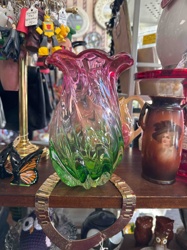
Submitted item photo
Submitted photo · June 27, 2026

User's notes

No additional notes provided.

AI analysis below

AI appraisal

AI analysis & estimate

AI-Generated · Verify before acting

Everything below is generated by AI for informational purposes only. AI can make mistakes — the AI may misidentify items or misattribute them (artist, maker, brand, designer, origin, era). This is not an official valuation and should not be used for insurance, sale, tax, estate, legal, or lending purposes — or any decision requiring a certified appraisal. It is not an authoritative claim about any person, brand, or rights holder — do not share or rely on it as a factual statement about a third party. Always consult qualified professionals before making financial decisions.

Read the full disclaimer

AI Identification

·Not independently authenticated·Verify before acting

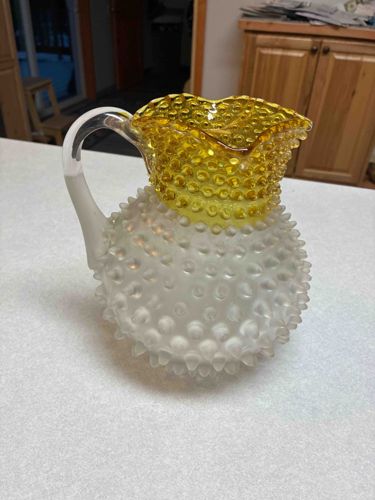
Fenton Hobnail Amberina Opalescent Glass Pitcher

Vintage Art Glass

AI Estimated Value

·Not an official valuation·Verify before acting

$45 - $80

As of June 27, 2026

AI Item Analysis

·AI can make mistakes·Verify before acting
This is a vintage bulbous-shaped glass pitcher featuring the classic 'Hobnail' pattern, likely manufactured by the Fenton Art Glass Company. The pitcher displays a striking 'Amberina' transition, where the glass color shifts from a deep honey-colored amber at the ruffled rim to a milky white opalescent finish at the base. The body is characterized by regularly spaced, cone-like protrusions known as hobnails, which are sharp and well-defined, indicating a high quality of mold work. The top of the pitcher features a multi-crimped or ruffled rim with a distinct pouring spout. A clear-to-opalescent applied 'reeded' style handle is attached at the neck and mid-body. In terms of condition, the glass appears bright with no visible cracks or heavy staining; however, with hobnail glass, closer inspection is often needed to check for 'flea bites' or tiny chips on the points of the hobnails. The piece likely dates from the mid-20th century (circa 1940s-1960s), a period when Fenton produced a wide variety of these opalescent hued items. The craftmanship is indicative of hand-pressed and hand-finished American art glass, showcasing a seamless color transition and elegant ruffling typical of skilled glassblowers.
AI Appraisal Report

·AI can make mistakes·Verify before acting
Based on my visual examination of the provided images, I identify this as a vintage Fenton Art Glass Hobnail pitcher. The 'Amberina' classification in the provided description appears slightly ambiguous based on the visual evidence; true Amberina typically transitions from ruby red to amber. The description detailing a 'honey-colored amber' shifting to 'milky white opalescent' more accurately describes Fenton's 'Honey Amber Opalescent' or possibly a variant of their 'Topaz Opalescent' line, likely produced during the mid-20th century (1940s-1950s). The double-crimped rim and applied reeded handle are classic indicators of authentic Fenton craftsmanship from this era. Condition appears excellent with no immediately visible cracks or severe cloudiness. However, with any hobnail piece, value is heavily dependent on the tactile condition of the individual 'hobs.' Photographs cannot reveal 'flea bites' (micro-chips) on the tips of the hobnails or stress fractures near the handle attachment, which are critical check-points for collectors. Market demand for Fenton remains steady but has softened from its peak; it is now a buyer's market for common shapes like pitchers. While the color transition is attractive, this specific shape and pattern combination is relatively available in the secondary market. To fully authenticate and maximize the valuation, I would need to physically inspect the handle joint for repairs and feel the rim for rough pontil marks or grinding that might indicate a 'second' quality piece. Without seeing a Fenton maker's mark (often absent on pre-1970s pieces), attribution relies on mold characteristics and color palette.

Get your items appraised

Instant estimates of your treasures with AI-powered appraisals

Browse More Appraisals