AI estimate as of September 7, 2025 · verify with a professional before acting
AI-Generated · Verify before acting
Everything on this page is generated by AI for informational purposes only. AI can make mistakes — the AI may misidentify items or misattribute them (artist, maker, brand, designer, origin, era). This is not an official valuation and should not be used for insurance, sale, tax, estate, legal, or lending purposes — or any decision requiring a certified appraisal. It is not an authoritative claim about any person, brand, or rights holder — do not share or rely on it as a factual statement about a third party. Always consult qualified professionals before making financial decisions.
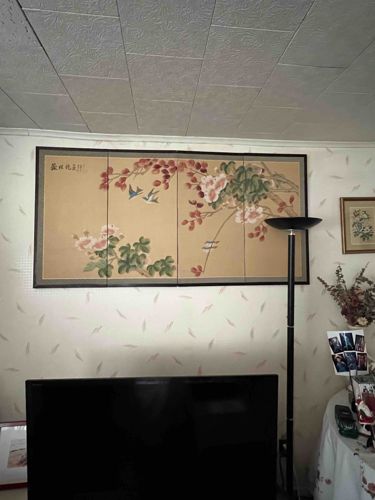
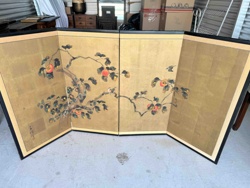
This item is a Japanese four-panel byobu, or folding screen, featuring a vibrant artistic depiction of birds, likely swifts or swallows, in flight among flowering branches, predominantly peonies and what appear to be berries or small fruit. The overall dimensions are substantial, dominating the wall space, suggesting a width of at least 6-8 feet and a height of 3-4 feet. The screen is composed of four individual panels, hinged together, and appears to be framed in a dark, possibly ebonized, wood. The artwork itself is rendered on a light tan or beige background, possibly silk or rice paper, which is subtly aged, contributing to a warm, antique aesthetic. The colors of the flora include various shades of pink, green, and reddish-brown for the flowers and foliage, while the birds are depicted in shades of blue and white. The pigment application appears to be traditional, likely gouache or mineral pigments, showing some blending and detailing characteristic of East Asian brush painting. There are visible creases where the panels meet, which is inherent to the construction of a folding screen. A vertical calligraphic inscription, likely a signature or poem, is present in the upper left corner of the leftmost panel. The overall condition appears to be good for its age, with no obvious signs of significant damage like tears or severe discoloration, though a gentle patina and slight fading might be present, consistent with age and exposure. The craftsmanship suggests a piece of reasonable quality, reflecting traditional Japanese artistic styles, likely from the mid-20th century or earlier, judging by the overall aesthetic and framing style. The subject matter of birds and flowers is common in Japanese art, often symbolizing prosperity, good fortune, and the beauty of nature.
AI Appraisal Report
Based on my visual examination of the provided image, this Japanese four-panel byobu, featuring birds and peonies, appears to be in good condition for its age. The artwork displays a traditional aesthetic, with what I perceive to be traditional pigments on a light-toned background, likely silk or paper. The colors, while possibly exhibiting some gentle patina and slight fading consistent with age, remain vibrant enough to convey the artistic intent. The dark framing appears intact. The visible creases where panels meet are expected for this type of construction.
From a market perspective, traditional Japanese decorative screens of this size and subject matter (kacho-ga or "bird-and-flower pictures") generally attract a steady demand. The presence of a calligraphic inscription in the upper left corner could indicate a signature, which, if authenticated, would enhance value. Comparables for unsigned, mid-20th century or earlier four-panel byobu in good condition typically fall within the $800-$1,500 range, sometimes higher for exceptional artistry or verifiable age. Rarity is moderate; while many screens exist, finely executed examples are less common.
Factors impacting value positively include the detailed brushwork and harmonious composition. However, without in-person examination, I cannot definitively confirm the age, original artist, or precise medium. A hands-on inspection would allow me to assess pigment type, substrate condition (e.g., silk vs. paper, any hidden repairs), frame integrity, and the true extent of any aging or damage. Full authentication would also require expert analysis of the calligraphy, provenance documentation, and potentially scientific testing of materials (e.g., dating pigments or substrate) to confirm its age and authenticity. These limitations prevent a more precise valuation.