AI estimate as of August 16, 2025 · verify with a professional before acting
AI-Generated · Verify before acting
Everything on this page is generated by AI for informational purposes only. AI can make mistakes — the AI may misidentify items or misattribute them (artist, maker, brand, designer, origin, era). This is not an official valuation and should not be used for insurance, sale, tax, estate, legal, or lending purposes — or any decision requiring a certified appraisal. It is not an authoritative claim about any person, brand, or rights holder — do not share or rely on it as a factual statement about a third party. Always consult qualified professionals before making financial decisions.
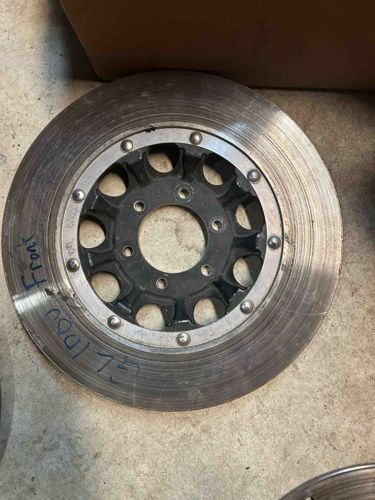
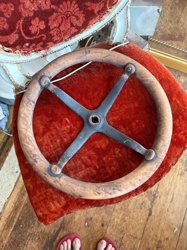
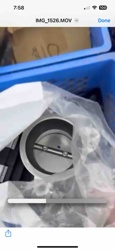
This item is a used motorcycle disc brake rotor (also known as a brake disc). It features a two-piece construction, common in performance or aftermarket rotors, consisting of a central hub (bell) made of a dark-colored, likely anodized aluminum alloy, and an outer friction ring made of steel or cast iron. The hub is black with multiple circular cut-outs or spokes for weight reduction and cooling, and a central circular opening for mounting onto a wheel hub. The friction ring is attached to the central hub by visible silver-colored rivets or floating bobbins, indicating a 'full floating' or 'semi-floating' design, which allows for thermal expansion and reduces warping. The surface of the friction ring shows clear signs of wear from brake pad contact, including concentric grooves and scoring across its entire braking surface. There is also a noticeable wear lip along the outer edge of the friction ring, suggesting significant use and material removal. The metal exhibits a dark, somewhat oxidized patina consistent with used ferrous metals. There are handwritten markings on the friction ring in blue, which appear to say 'Front' and possibly 'RMDL 73' or similar alphanumeric designations, likely inventory or fitment notes from a mechanic. A small chip or imperfection is visible along the outer edge of the friction ring in one area. The overall condition suggests it is a used part that has been in service, showing typical wear and tear but no catastrophic damage visible from this angle. The two-piece design points to a mid-to-late 20th century or early 21st-century motorcycle application, possibly for a sportbike or higher-performance cruiser due to the floating design and vented hub.
AI Appraisal Report
Upon examining the provided image of this motorcycle floating brake disc rotor, I assess its condition as 'used' with significant wear typical of a component that has been in active service. The visible concentric grooves, scoring on the friction surface, and the wear lip along the outer edge clearly indicate material removal from extensive brake pad contact. The dark, somewhat oxidized patina is consistent with used ferrous metals. The handwritten markings 'Front' and 'RMDL 73' are likely inventory or fitment notes and do not diminish value, though they confirm its used status. The small chip on the outer edge is minor but noted. The two-piece 'floating' design, employing a central aluminum hub and steel friction ring connected by visible bobbins, suggests this is a performance-oriented or aftermarket component, designed to manage thermal expansion and prevent warping under heavy braking. This design is commonly found on sportbikes or high-performance cruisers from the mid-to-late 20th century or early 21st century.
From the image alone, I cannot definitively verify its authenticity as an OEM part versus a high-quality aftermarket reproduction, nor can I assess its structural integrity or the precise amount of remaining usable material (minimum thickness). A physical examination would be necessary to measure the disc thickness, inspect for runout, assess the condition of the floating bobbins for play, and detect any heat cracks not visible in the image. Provenance documentation (e.g., original purchase receipts, vehicle history) would also be crucial to confirm its origin and fitment.
Market conditions for used brake components are highly variable. While new floating rotors can retail for hundreds of dollars each, used rotors, even high-quality ones, typically fetch a fraction of that due to wear and safety concerns. Demand for specific used parts depends on the motorcycle make and model it fits; if it's for a popular model, demand increases, but rarity often corresponds to specialized or older bikes, making specific fitment hard to ascertain from the image. Given the visible wear, this rotor would likely be considered for 'rider' use rather than 'concours' restoration. Comparable used floating rotors in good, but not perfect, condition on platforms like eBay or specialist forums typically range from $50 to $150.
Factors significantly impacting its value include the unknown remaining life (thickness), the specific motorcycle application, and potential underlying structural issues not visible. Without knowing the exact application or being able to physically inspect it, its utility is limited.