AI estimate as of October 25, 2025 · verify with a professional before acting
AI-Generated · Verify before acting
Everything on this page is generated by AI for informational purposes only. AI can make mistakes — the AI may misidentify items or misattribute them (artist, maker, brand, designer, origin, era). This is not an official valuation and should not be used for insurance, sale, tax, estate, legal, or lending purposes — or any decision requiring a certified appraisal. It is not an authoritative claim about any person, brand, or rights holder — do not share or rely on it as a factual statement about a third party. Always consult qualified professionals before making financial decisions.
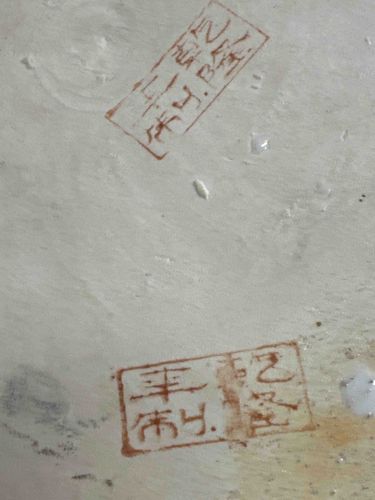
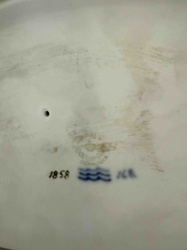
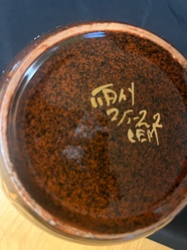
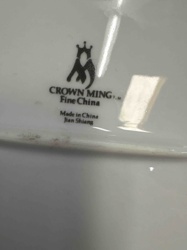
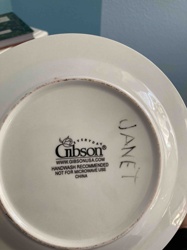
The item depicted is a section of what appears to be the unglazed or partially glazed base of a ceramic, most likely porcelain, object. The primary features are two distinct, rectangular red seals, commonly known as 'chop marks' or 'seal marks', applied in an underglaze or overglaze pigment. These marks are characteristic of traditional East Asian ceramics, particularly Chinese and Japanese ware. The background surface is an off-white to light gray, suggesting a porcelain or earthenware body, which appears somewhat unevenly finished, indicating a handmade or artisan-crafted piece rather than mass-produced uniformity. There are visible imperfections in the ceramic body, such as small bumps or inconsistencies in the surface texture, and what seems to be a light layer of dirt or residue, particularly around the lower seal. The red pigment used for the seals is somewhat faded and indistinct in places, but overall legible. Each seal contains several vertical lines of stylized characters, likely Chinese ideograms. The upper seal is oriented diagonally relative to the image frame, and the lower seal is more horizontally aligned. The condition suggests age and use, with a visible patina and general wear rather than significant damage like chips or cracks. The clarity of the marks, despite some fading, indicates a relatively good state of preservation for identifying the maker or period. These marks are crucial for attributing the ceramic piece to a specific manufacturer, studio, artist, or dynastic period.
AI Appraisal Report
Based on my visual examination of the provided image, the ceramic markings present appear to be two indistinct red seal marks on what seems to be the unglazed or partially glazed base of a porcelain object. The surface shows an uneven finish and minor imperfections consistent with artisan crafting rather than mass production. The red pigment of the seals is somewhat faded and indistinct in areas, suggesting age and use, aligning with a general patina and wear rather than significant damage. The clarity of the marks, despite fading, is sufficient to indicate traditional Chinese or East Asian origin. However, the specific characters within the seals are not decipherable from this image, which is a critical limitation.
My assessment of condition, based purely on visual cues, suggests fair to good condition for the base itself, with expected wear for an aged piece. Authenticity of the ceramic piece itself and the marks cannot be definitively determined from images alone. Without legible characters, it's impossible to attribute these marks to a specific artist, workshop, or dynastic period. This significantly impacts value, as specific reign marks or artist seals can command substantial premiums.
Market conditions for unmarked or unidentifiable Chinese porcelain vary widely. Generic pieces typically fetch modest prices. Demand for unidentifiable pieces is low compared to those with clear provenance or attribution. Rarity is also impossible to assess without knowing the origin.
Factors significantly impacting value here are the undecipherable marks. If these marks were legible and identified a renowned artist, significant period, or imperial kiln, the value could range from thousands to tens of thousands of dollars. Conversely, if they are common decorative marks or later reproductions, the value would be minimal.
For full authentication and accurate valuation, an in-person examination is absolutely necessary. This would involve a specialist examining the ceramic body, glaze, firing techniques, and, most importantly, the actual characters of the seals under magnification. Provenance documentation (receipts, previous ownership records) would be invaluable. Scientific testing, such as thermoluminescence dating, could confirm age but would not define authorship. Without definitive identification of the marks, the value is speculative, hence my conservative estimate based on the potential of a period, albeit unknown, ceramic base.