AI estimate as of November 8, 2025 · verify with a professional before acting
AI-Generated · Verify before acting
Everything on this page is generated by AI for informational purposes only. AI can make mistakes — the AI may misidentify items or misattribute them (artist, maker, brand, designer, origin, era). This is not an official valuation and should not be used for insurance, sale, tax, estate, legal, or lending purposes — or any decision requiring a certified appraisal. It is not an authoritative claim about any person, brand, or rights holder — do not share or rely on it as a factual statement about a third party. Always consult qualified professionals before making financial decisions.
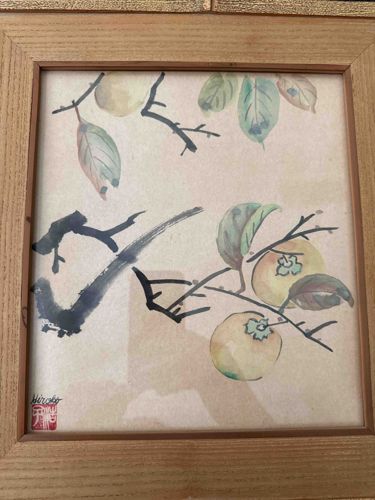
This is a framed watercolor or sumi-e style painting depicting a branch laden with persimmons and leaves. The physical characteristics suggest it is a relatively small artwork, likely encased in a simple wooden frame. The frame appears to be made of a light-colored wood, possibly oak or pine, with a visible grain and a natural, unstained finish. The corners of the frame are mitered. The artwork itself is rendered on a light, possibly cream or beige-colored paper or thin board, which shows some subtle texture, typical of rice paper or absorbent watercolor paper. The colors used are muted and earthy, characteristic of traditional East Asian ink wash painting. The persimmons are depicted in shades of pale yellow and orange, with subtle green undertones, suggesting ripeness. The leaves are rendered in various shades of green, some appearing faded or autumn-tinged, with visible vein details. The branches are painted with bold, dark, calligraphic brushstrokes, showcasing the artist's control over ink. One prominent branch swoops dramatically across the left side of the composition. In the lower left corner, there is a visible signature, appearing to be in ink, 'Hiroko', followed by a red square chop mark (artist's seal), a common feature in East Asian art. The condition of the painting appears good, with no obvious tears or significant discoloration, though the paper might have some slight age-related toning. The frame also seems to be in good condition with minor wear consistent with its age. The style suggests a 20th-century or contemporary creation, drawing heavily from traditional Japanese or Chinese painting techniques, emphasizing natural forms and skilled brushwork. The quality is indicative of thoughtful craftsmanship, particularly in the fluid and confident ink lines.
AI Appraisal Report
Based on my visual examination of the provided image, this Japanese Sumi-e style persimmon branch painting appears to be in good condition. The artwork itself shows no obvious tears, significant discoloration, or foxing. The paper may exhibit some subtle age-related toning, which is expected for such a piece. The simple wooden frame is also in good condition, with minor wear consistent with its age. The visible signature 'Hiroko' and the red chop mark are common in East Asian art, lending credence to its artistic origin, though full authenticity verification would require in-person inspection.
The style indicates a 20th-century or contemporary creation, drawing on traditional Japanese or Chinese sumi-e techniques. The brushwork is confident, and the depiction of the persimmons and leaves is well-executed, showing thoughtful craftsmanship. The market for contemporary sumi-e style paintings by lesser-known artists varies. While there's a steady appreciation for East Asian art, this piece does not feature a known, highly sought-after artist, which is a key factor impacting value. Demand for decorative sumi-e art is moderate, especially for pieces that can complement various interior styles.
Factors impacting value include the good condition, appealing subject matter, and competent execution. However, the lack of a prominent artist's name and the absence of provenance documentation limit the top-end value. For a definitive assessment of authenticity, including confirming the artist's identity and the age of the piece, an in-person examination would be crucial. This would allow for a closer inspection of the paper, pigments, and the precise nature of the chop mark. Provenance documentation, such as exhibition history or prior ownership records, would also significantly enhance its verified value. Without these, my appraisal is based purely on observed aesthetic and condition merits within its likely market segment.