Victorian Era Majolica Style Ceramic Jardinière
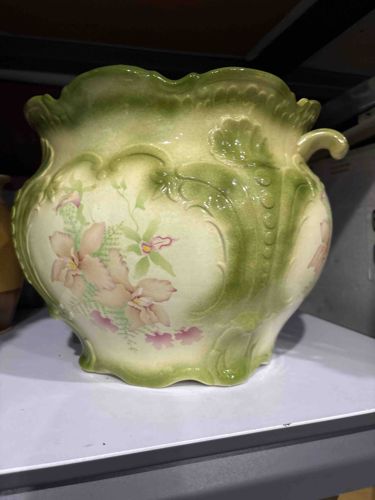
A high-gloss ceramic jardinière, or decorative cachepot, featuring an ornate Rococo-revival aesthetic typical of the late 19th or early 20th century. The vessel is constructed with a heavily molded, scalloped rim and a bulbous, lobed body characterized by dramatic relief carvings of scrolling acanthus leaves and beaded accents. The color palette utilizes a blend of sage green and a pale cream or 'clobbered' yellow base. A delicate floral motif, likely applied via decal or transfer ware and then hand-emphasized, depicts pale pink and mauve orchids or lilies and fine greenery on the central panel. The piece features a singular arched handle visible on the right, suggesting a potential missing counterpart or a unique asymmetrical design. The glaze exhibits fine vertical crazing throughout, consistent with substantial age and the natural expansion and contraction of the clay body over time. There are minor abrasions and small glaze skips typical of production pieces of this era. Though no maker's mark is visible in the shot, the craftsmanship suggests a mass-produced yet high-quality decorative piece from a notable European or American pottery works such as Roseville (early periods), Weller, or a Continental manufacturer from the Art Nouveau transition.
AI-Generated Appraisal Disclaimer
Estimated Value
$125 - $225
Basic Information
Category
Antique Ceramics and Pottery
Appraised On
April 8, 2026
Estimated Value
$125 - $225
Item Description
A high-gloss ceramic jardinière, or decorative cachepot, featuring an ornate Rococo-revival aesthetic typical of the late 19th or early 20th century. The vessel is constructed with a heavily molded, scalloped rim and a bulbous, lobed body characterized by dramatic relief carvings of scrolling acanthus leaves and beaded accents. The color palette utilizes a blend of sage green and a pale cream or 'clobbered' yellow base. A delicate floral motif, likely applied via decal or transfer ware and then hand-emphasized, depicts pale pink and mauve orchids or lilies and fine greenery on the central panel. The piece features a singular arched handle visible on the right, suggesting a potential missing counterpart or a unique asymmetrical design. The glaze exhibits fine vertical crazing throughout, consistent with substantial age and the natural expansion and contraction of the clay body over time. There are minor abrasions and small glaze skips typical of production pieces of this era. Though no maker's mark is visible in the shot, the craftsmanship suggests a mass-produced yet high-quality decorative piece from a notable European or American pottery works such as Roseville (early periods), Weller, or a Continental manufacturer from the Art Nouveau transition.
Get Your Items Appraised
Instant estimates of your treasures with AI-powered instant appraisals