AI Appraisal Estimate

AI-generated estimates · not official valuations

From the user

What was submitted

Photo and notes provided by the user — not generated by AI

Submitted item photo
Submitted photo · June 1, 2026

User's notes

No additional notes provided.

AI analysis below

AI appraisal

AI analysis & estimate

AI-Generated · Verify before acting

Everything below is generated by AI for informational purposes only. AI can make mistakes — the AI may misidentify items or misattribute them (artist, maker, brand, designer, origin, era). This is not an official valuation and should not be used for insurance, sale, tax, estate, legal, or lending purposes — or any decision requiring a certified appraisal. It is not an authoritative claim about any person, brand, or rights holder — do not share or rely on it as a factual statement about a third party. Always consult qualified professionals before making financial decisions.

Read the full disclaimer

AI Identification

·Not independently authenticated·Verify before acting

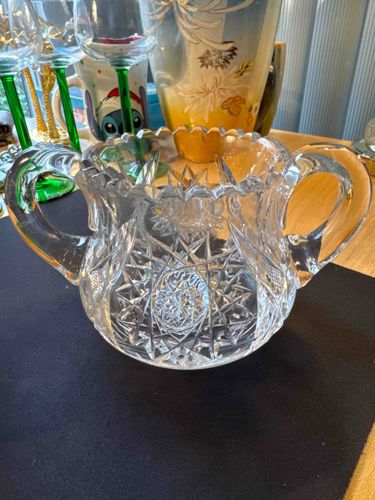
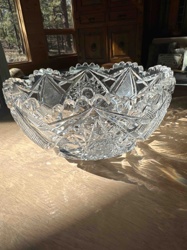
American Brilliant Period Cut Glass Open Sugar Bowl

Antique Glassware / American Brilliant Period Cut Glass

AI Estimated Value

·Not an official valuation·Verify before acting

$125 - $175

As of June 1, 2026

AI Item Analysis

·AI can make mistakes·Verify before acting
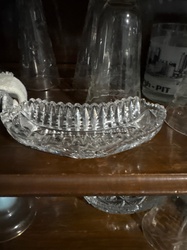
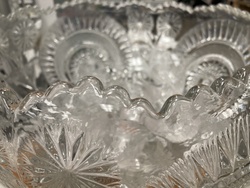
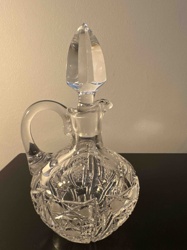
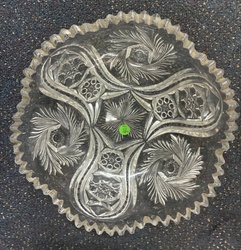
This is an American Brilliant Period (ABP) double-handled open sugar bowl, dating approximately from 1876 to 1916. The vessel is crafted from high-lead-content heavy crystal, which provides its characteristic brilliance, weight, and clarity. The exterior surface is extensively hand-cut with traditional motifs, including large hobstar rosettes, cross-hatched diamonds, and vertical fan cuts. The rim features a scalloped, 'sawtooth' edge common to high-quality cut glass of the era. Two large, smooth, C-shaped handles are applied to the sides, showing a polished finish that contrasts with the prismatic geometry of the bowl's body. The piece exhibits a bulbous, rounded form tapering slightly toward the base. In terms of condition, the glass appears bright with no significant clouding or 'sick' glass symptoms, though minor 'fleabites' or small nicks are likely present on the sharp edges of the sawtooth rim and the points of the hobstars—typical for utilitarian crystal of this age. There are no visible large cracks or structural repairs. The craftsmanship indicates a high level of skill, likely from a notable American manufacturer such as Libbey, Hawkes, or Dorflinger, though no specific acid-etched signature is immediately visible in the provided image.
AI Appraisal Report

·AI can make mistakes·Verify before acting
Based on my visual inspection, this American Brilliant Period (ABP) open sugar bowl is a characteristic example of early 20th-century craftsmanship (c. 1890-1910). The high lead content is evident through the sharp light refraction and clarity of the thick-walled crystal. The 'sawtooth' rim and deep-cut hobstar rosettes indicate a high-quality hand-cutting process rather than cheaper pressed-glass imitations. The condition appears consistent with its age; while the glass remains clear and free of 'sickness,' the inevitable 'fleabites' on the intricate cutting points are noted and slightly temper the valuation. The market for ABP glass has softened significantly from its peak in the 1990s. While items like punch bowls or signed rarities command high premiums, utilitarian pieces like sugar bowls—even of this quality—are more common. This piece lacks a visible signature from premier houses like Hawkes or Libbey, placing it in the mid-range of the collector market. Comparable sales for unsigned ABP sugar bowls of this complexity typically fall within the $125 to $175 range. Limitation of Authenticity: This appraisal is based strictly on photographic evidence. A definitive authentication requires an in-person examination to verify the 'ring' (resonance) of the lead crystal, the presence of oxidation, and a microscopic inspection for acid-etched marks that may be faint. Furthermore, checking for 'black light' fluorescence would confirm the absence of modern high-manganese replacements. Provenance documentation or original catalog matching would further solidify the attribution to a specific glass house.

Get your items appraised

Instant estimates of your treasures with AI-powered appraisals

Browse More Appraisals