AI estimate as of December 5, 2025 · verify with a professional before acting
AI-Generated · Verify before acting
Everything on this page is generated by AI for informational purposes only. AI can make mistakes — the AI may misidentify items or misattribute them (artist, maker, brand, designer, origin, era). This is not an official valuation and should not be used for insurance, sale, tax, estate, legal, or lending purposes — or any decision requiring a certified appraisal. It is not an authoritative claim about any person, brand, or rights holder — do not share or rely on it as a factual statement about a third party. Always consult qualified professionals before making financial decisions.
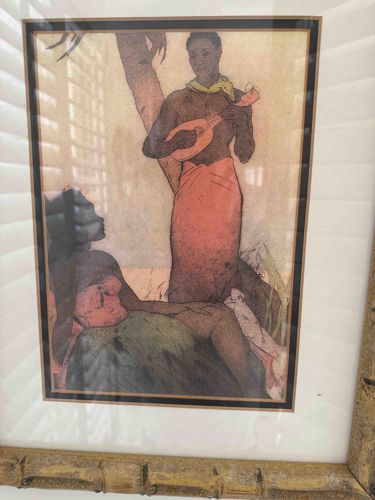
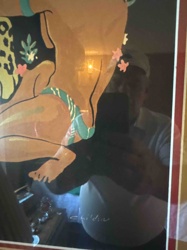
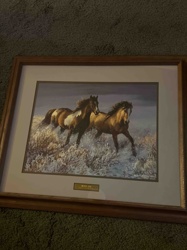
This item is a framed print depicting a scene characteristic of Paul Gauguin's Tahitian period. The print features two figures and is commonly recognized as 'Te Tiare Farani' (The French Flower). The composition shows a dark-skinned male figure standing casually beneath what appears to be a tree or large plant, holding and looking into a stringed instrument resembling a mandolin or ukulele. He is adorned with a yellow neck covering or scarf and a reddish-orange wrap around his lower body. To his left, a dark-skinned female figure reclines, gazing upwards towards the standing man. She is partially draped in a similar reddish-orange fabric covering her chest and mid-section, while a dark green fabric covers her lower body and the surface she rests upon. A white bird, possibly a parrot, is depicted near her leg. The overall color palette is warm, with dominant earthy tones, reddish-oranges, and subtle greens, set against a lighter, somewhat faded background suggesting an outdoor tropical setting. The print exhibits a distinct stippled or cross-hatched texture visible upon closer inspection, indicative of a reproduction technique like a mezzotint or a textured print common in later reproductions, rather than an original painting or woodblock print. The print is housed within a black interior frame, which is then surrounded by a white mat, and finally by a faux-bamboo style outer frame. The bamboo frame appears to be made of wood, possibly stained or painted to mimic natural bamboo, showing signs of wear and age with some discoloration and scuffs, particularly noticeable in the bottom right corner. The print itself appears to be in good condition behind glass, with no immediately discernible rips, tears, or significant discoloration, though minor fading typical of older prints might be present. The visible texture and framing suggest it's a decorative art piece from the mid-to-late 20th century, reproducing an iconic Post-Impressionist work.
AI Appraisal Report
Based on my visual examination of the images provided, I have appraised this framed print of Paul Gauguin's 'Te Tiare Farani'. The item is clearly a decorative reproduction, not an original work by the artist. This conclusion is based on the visible stippled texture, which is characteristic of mass-produced commercial printing techniques from the mid-to-late 20th century, rather than an original painting, woodcut, or fine art lithograph. The print appears to be in good condition behind glass, with no obvious tears or water damage, though some age-related fading is likely. The faux-bamboo wooden frame, while stylistically appropriate, shows noticeable wear, including scuffs and discoloration, which moderately detracts from its overall decorative appeal.
The market for such mass-produced decorative prints is driven primarily by aesthetic appeal rather than artistic rarity or investment potential. Comparable framed Gauguin prints from this era typically sell in the secondary market (e.g., online auctions, thrift stores, and estate sales) in the low-to-modest price range. The primary value lies in its function as a ready-to-hang piece of decor.
It is crucial to note that this appraisal is based solely on digital images. A full authentication would require physical inspection to examine the printing method, paper type, and any publisher's marks. However, given the evidence, the probability of this being anything other than a commercial reproduction is exceedingly low. The value assigned reflects its status as a decorative object.