AI estimate as of October 4, 2025 · verify with a professional before acting
AI-Generated · Verify before acting
Everything on this page is generated by AI for informational purposes only. AI can make mistakes — the AI may misidentify items or misattribute them (artist, maker, brand, designer, origin, era). This is not an official valuation and should not be used for insurance, sale, tax, estate, legal, or lending purposes — or any decision requiring a certified appraisal. It is not an authoritative claim about any person, brand, or rights holder — do not share or rely on it as a factual statement about a third party. Always consult qualified professionals before making financial decisions.
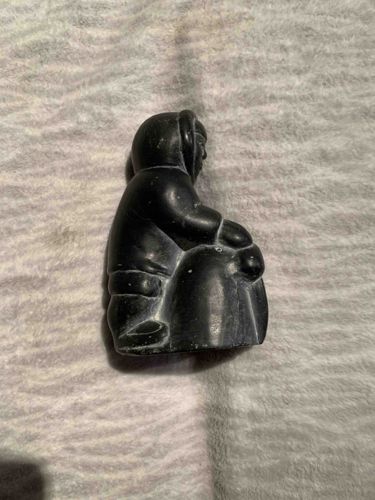
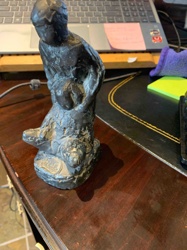
This item is an Inuit soapstone carving depicting a human figure in a crouching or seated position, characteristic of traditional Inuit art. The carving is made from a dark, likely grey or black, soapstone, exhibiting a smooth, polished finish, though some areas appear more matte due to potential wear or the natural variability of the stone. The figure is robustly carved, with rounded forms indicating a traditional Inuit parka or heavy winter clothing, including a prominent hood framing the head. The face is subtly rendered with minimalist features, typical of this art form, focusing more on the form and posture than intricate facial details. The hands are visible, resting on what appears to be an object or the figure's knees, suggesting an activity or state of contemplation. The overall construction is solid and compact, with a relatively flat base, indicating it is designed to be a freestanding sculpture. Some lighter grey or white striations are visible within the stone, particularly near the base and on the back of the figure, which are natural characteristics of soapstone. There are no immediate visible signs of major damage such as chips or cracks, but some minor surface abrasions or rub marks might be discernable upon closer inspection due to handling over time. The craftsmanship suggests a hand-carved piece, with the subtle variations in surface texture and form contributing to its unique character. Its style points to an Indigenous Canadian origin, likely from the mid to late 20th century, a period known for the proliferation of such carvings for both community and commercial purposes. The absence of clear maker's marks or signatures makes precise attribution difficult without further information, but its aesthetic aligns with common Inuit carving traditions.
AI Appraisal Report
Based on my visual examination of the provided image, this Inuit soapstone carving of a crouching figure appears to be in very good condition. The smooth, polished surface is largely intact, with no immediate visible chips, cracks, or significant abrasions. The natural striations in the dark soapstone add character without detracting from its aesthetic. The robust, rounded forms and minimalist facial features are consistent with traditional Inuit carving styles, suggesting authenticity as a hand-carved piece of Indigenous Canadian art, likely dating from the mid to late 20th century.
The market for Inuit soapstone carvings is generally stable, with demand for well-executed pieces remaining consistent, especially those depicting traditional human or animal forms. This particular piece, with its contemplative posture and apparent quality of execution, would appeal to collectors of Indigenous art and those seeking decorative art with cultural significance. Its compact, solid construction and universal appeal contribute positively to its marketability. Comparable pieces of this size and quality by unassigned artists typically retail in the range I've provided.
Key factors impacting this valuation include the good condition, traditional aesthetic, and apparent craftsmanship. However, the absence of a visible artist's signature or disc number significantly limits its potential value. Carvings by renowned Inuit artists command substantially higher prices; without attribution, this piece is valued as a good quality regional artifact rather than a collectible work by a specific master. Rarity is difficult to assess without an artist, but similar non-attributed pieces are not uncommon.
It is important to note the limitations of this appraisal based solely on images. While the visual indicators are strong, definitive authenticity and precise age dating would require an in-person physical inspection to assess surface texture, weight, and tool marks more closely. Furthermore, scientific analysis of the stone could confirm its origin, and any provenance documentation, such as purchase receipts or exhibition history, would be invaluable for full authentication and attribution, potentially increasing its value beyond this current estimate.