Meissen Blue Onion (Zwiebelmuster) Pattern Porcelain Plate
Antique Ceramics and Porcelain

Meissen Blue Onion (Zwiebelmuster) Pattern Porcelain Plate

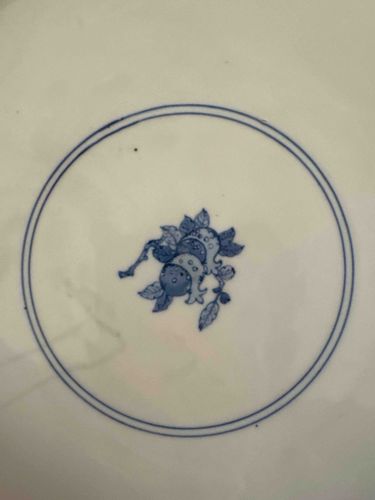
This is a close-up image of the central well of a fine porcelain plate, featuring the iconic Blue Onion (Zwiebelmuster) pattern. The piece is constructed from high-quality white hard-paste porcelain with a translucent, milky appearance. The decoration is applied in underglaze cobalt blue, a technique pioneered in Meissen to ensure permanent pigment adhesion. Centered within a hand-painted double-line blue ring is a cluster of pomegranate and peach motifs, which were stylized by European artists in the 18th century based on Chinese export porcelain originals. The blue pigment shows characteristic 'bleeding' or softening at the edges, typical of authentic underglaze work. The craftsmanship is evident in the fine details of the foliage and the stippling within the fruit. Condition-wise, the glaze appears vibrant with no visible crazing, though a small dark kiln speck is visible near the top left of the ring, which is common in early-to-mid period production. No chips or cracks are detectable in this view. This pattern originated around 1730 and has been in continuous production, representing a cornerstone of the Rococo and Chinoiserie style. The depth of the blue and the clarity of the porcelain suggest a mid-19th to early-20th-century production date, though a full inspection of the crossed swords mark on the reverse would be required for precise dating.
Estimated Value

$150-250

Basic Information

Category

Antique Ceramics and Porcelain

Appraised On

December 31, 2025

Estimated Value

$150-250

Item Description

This is a close-up image of the central well of a fine porcelain plate, featuring the iconic Blue Onion (Zwiebelmuster) pattern. The piece is constructed from high-quality white hard-paste porcelain with a translucent, milky appearance. The decoration is applied in underglaze cobalt blue, a technique pioneered in Meissen to ensure permanent pigment adhesion. Centered within a hand-painted double-line blue ring is a cluster of pomegranate and peach motifs, which were stylized by European artists in the 18th century based on Chinese export porcelain originals. The blue pigment shows characteristic 'bleeding' or softening at the edges, typical of authentic underglaze work. The craftsmanship is evident in the fine details of the foliage and the stippling within the fruit. Condition-wise, the glaze appears vibrant with no visible crazing, though a small dark kiln speck is visible near the top left of the ring, which is common in early-to-mid period production. No chips or cracks are detectable in this view. This pattern originated around 1730 and has been in continuous production, representing a cornerstone of the Rococo and Chinoiserie style. The depth of the blue and the clarity of the porcelain suggest a mid-19th to early-20th-century production date, though a full inspection of the crossed swords mark on the reverse would be required for precise dating.
Get Your Items Appraised

Instant estimates of your treasures with AI-powered instant appraisals

Browse More Appraisals