AI estimate as of October 18, 2025 · verify with a professional before acting
AI-Generated · Verify before acting
Everything on this page is generated by AI for informational purposes only. AI can make mistakes — the AI may misidentify items or misattribute them (artist, maker, brand, designer, origin, era). This is not an official valuation and should not be used for insurance, sale, tax, estate, legal, or lending purposes — or any decision requiring a certified appraisal. It is not an authoritative claim about any person, brand, or rights holder — do not share or rely on it as a factual statement about a third party. Always consult qualified professionals before making financial decisions.
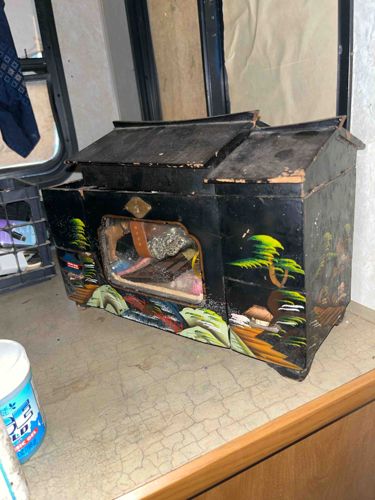
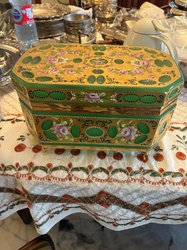
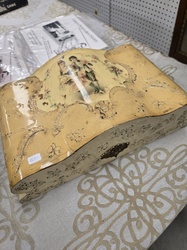
This item appears to be an antique or vintage Japanese lacquerware box, potentially functioning as a music box or a decorative diorama shrine. Its primary material is wood, coated in a black lacquer finish. The box is rectangular with a prominent architectural top, mimicking a traditional Japanese roofline, which is separated into two distinct sections. Both roof sections show significant wear, with the black lacquer chipped away to reveal the lighter underlying wood, particularly along the edges and peaks. The body of the box is elaborately decorated with hand-painted scenes using bright, contrasting colors, predominantly greens, yellows, oranges, and reds. These scenes depict landscapes often found in traditional Japanese art, featuring stylized trees (some resembling bonsai or pine trees), mountains, and what could be pagodas or small houses within the mountainous terrain. A notable feature is a rectangular opening on the front, covered by what looks like glass or clear plastic, creating a 'window' into the interior. Inside this windowed compartment, some elements are discernible, including what might be small figures or decorative items, although they are indistinct due to lighting and resolution. Below this window, the painted landscape continues, showcasing a wavy, possibly water-like pattern. On the front panel, above the window, there is a diamond-shaped brass or metallic escutcheon, suggesting a keyhole or a latch mechanism, though no lock is visible. The overall condition is poor, with substantial loss of lacquer, scratches, scuffs, and dirt accumulation across its surfaces, indicative of significant age and handling or neglect. The intricate painting, despite the damage, suggests a certain level of craftsmanship. The item exhibits characteristics of early to mid-20th-century Japanese decorative arts, possibly from the Taisho or early Showa periods, where such ornate lacquerware was popular for souvenirs or household decorations. Its unique architectural form and visible internal elements suggest it was designed to house a mechanism or display small objects, elevating it beyond a simple storage box.
AI Appraisal Report
Upon visual examination of this Vintage Japanese Lacquerware Music Box or Diorama Shrine, I assess its condition as poor. There is substantial loss of black lacquer, particularly on the architectural roofline and edges, revealing the underlying wood. Numerous scratches, scuffs, and dirt accumulation are evident across all surfaces. Despite the damage, the intricate hand-painted scenes, utilizing a vibrant palette, suggest a certain level of craftsmanship indicative of early to mid-20th-century Japanese decorative arts, possibly Taisho or early Showa periods. The diamond-shaped escutcheon and the internal 'window' compartment hint at its original function as either a music box or a diorama, adding to its unique architectural form.
Market conditions for vintage Japanese lacquerware can be variable, with demand being strongest for pieces in excellent condition with clear provenance. Comparables for heavily damaged items like this, especially those with an unknown internal mechanism (if it was indeed a music box), tend to fetch lower prices. The rarity of its specific combined architectural form and potential diorama/music box function is intriguing, but this is significantly offset by its poor state of preservation. Factors severely impacting its value include the extensive lacquer loss, general wear, and the indistinct nature of the interior compartment, which makes its original purpose less clear.
Without a hands-on examination, I cannot definitively confirm the authenticity of the materials, the exact age, or the functionality of any internal mechanisms. An in-person inspection would be crucial to assess the wood type, the technique of the lacquer application, the exact nature of the interior elements, and any mechanical components. Provenance documentation would be invaluable for dating and verifying its origin. Limitations in visual assessment mean this appraisal focuses on its current aesthetic and condition rather than fully verified historical or functional completeness.