AI estimate as of August 16, 2025 · verify with a professional before acting
AI-Generated · Verify before acting
Everything on this page is generated by AI for informational purposes only. AI can make mistakes — the AI may misidentify items or misattribute them (artist, maker, brand, designer, origin, era). This is not an official valuation and should not be used for insurance, sale, tax, estate, legal, or lending purposes — or any decision requiring a certified appraisal. It is not an authoritative claim about any person, brand, or rights holder — do not share or rely on it as a factual statement about a third party. Always consult qualified professionals before making financial decisions.
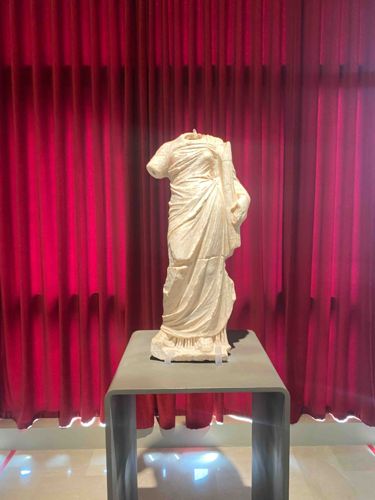
The item is a partial, ancient-style sculpture, likely depicting a draped female figure from the torso down to approximately the knees. It is executed in a light-colored, possibly off-white or cream-colored, material that strongly resembles marble or a similar stone, suggesting classical origins or a faithful reproduction. The figure is headless and has both arms missing, with breaks visible at the shoulders and neck. The drapery of the garment is a prominent feature, rendered with soft, flowing folds that suggest movement and the natural fall of fabric, indicative of high-quality carving often seen in Greco-Roman statuary. The details of the fabric manipulation are quite fine, creating realistic shadows and highlights. There are no obvious visible condition issues beyond the significant missing parts, which appear to be ancient breaks rather than recent damage. The surface shows a subtle sheen, typical of polished stone, and appears relatively clean, lacking significant dirt or heavy patination often accumulated over centuries. The base of the sculpture, though obscured, appears to be integrated into the figure's original form, resting on small, almost imperceptible supports or feet where it meets the modern display plinth. No visible maker's marks or signatures are discernable from the image. The style points towards either a classical antiquity (Roman or Greek) or a neoclassical revival piece, likely dating from antiquity given the nature of the breaks and common archaeological finds. The craftsmanship is high, evidenced by the detailed and naturalistic rendering of the drapery.
AI Appraisal Report
Upon examining the provided image of this draped female torso, I assess it to be a compelling example of classical or neoclassical statuary. The quality of the drapery carving, with its soft, flowing folds and naturalistic rendering, strongly suggests a high level of craftsmanship consistent with ancient Greco-Roman workshops or highly skilled neoclassical revival artists. The material appears to be fine-grained marble, further supporting its potential classical origin.
The condition, while missing the head and arms, appears stable. The breaks at the neck and shoulders seem ancient, showing characteristic fracture patterns rather than sharp, recent damage. The surface is relatively clean, indicating either careful preservation or recent cleaning.
Authenticity is the primary determinant of value here. Based solely on the image, it possesses hallmarks of antiquity, yet distinguishing it definitively from a masterfully crafted 18th-19th century neoclassical piece is challenging without direct inspection. Ancient examples, especially those of high artistic merit even if fragmentary, command significant prices due to rarity and historical importance. Neoclassical pieces, while valuable, typically do not reach the same price points unless by a renowned artist.
Market demand for authentic classical sculpture remains strong, particularly for pieces exhibiting such finely carved drapery. However, the fragmentary nature limits appeal for some collectors. For definitive authentication, I would require a physical examination to assess the stone's patination, tool marks, and crystallization, alongside thermoluminescence dating if deemed appropriate. Provenance documentation, detailing the item's history since excavation or creation, would also be critical for full authentication and valuation. Without these, any assessment of authenticity remains provisional.
Considering the current market for classical fragments and the high quality suggested by the carving, factoring in the potential for either ancient or high-quality neoclassical origin, the value range reflects this uncertainty.