Rough Beryl Crystal Specimen
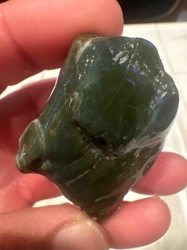
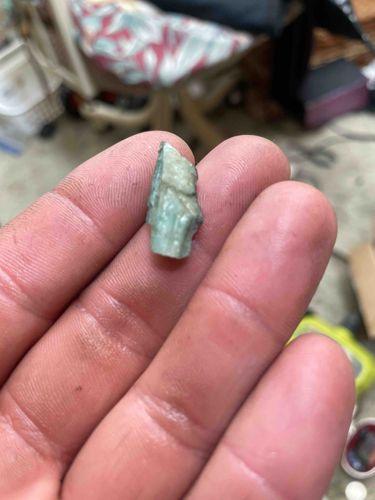
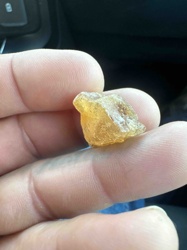
This item is a small, rough mineral specimen, likely a variety of beryl such as aquamarine or a low-grade emerald, held between human fingers for scale. It measures approximately 1 to 1.5 centimeters in length. The crystal exhibits a predominantly pale bluish-green to seafoam green hue with a matte to sub-vitreous luster. Its construction is natural and irregular, displaying a tabular or slightly elongated hexagonal prismatic habit characteristic of the beryl family, though the crystal faces are heavily weathered or abraded. Notable features include visible internal fractures and a cloudy, translucent-to-opaque clarity, suggesting significant mineral inclusions. The condition is raw and unpolished, with jagged, chipped edges and a dusty surface patina. There are no maker's marks or signatures as it is a natural geological find. The specimen appears to be of 'gem-grade' potential but currently lacks the transparency or size required for high-end faceting. It serves as a study-grade mineral sample or a fossick find, representing an example of silicates formed in pegmatite environments.
AI-Generated Appraisal Disclaimer
Estimated Value
$5 - $15 USD
Basic Information
Category
Minerals and Gemstones
Appraised On
December 23, 2025
Estimated Value
$5 - $15 USD
Item Description
This item is a small, rough mineral specimen, likely a variety of beryl such as aquamarine or a low-grade emerald, held between human fingers for scale. It measures approximately 1 to 1.5 centimeters in length. The crystal exhibits a predominantly pale bluish-green to seafoam green hue with a matte to sub-vitreous luster. Its construction is natural and irregular, displaying a tabular or slightly elongated hexagonal prismatic habit characteristic of the beryl family, though the crystal faces are heavily weathered or abraded. Notable features include visible internal fractures and a cloudy, translucent-to-opaque clarity, suggesting significant mineral inclusions. The condition is raw and unpolished, with jagged, chipped edges and a dusty surface patina. There are no maker's marks or signatures as it is a natural geological find. The specimen appears to be of 'gem-grade' potential but currently lacks the transparency or size required for high-end faceting. It serves as a study-grade mineral sample or a fossick find, representing an example of silicates formed in pegmatite environments.
Related Tags
Get Your Items Appraised
Instant estimates of your treasures with AI-powered instant appraisals