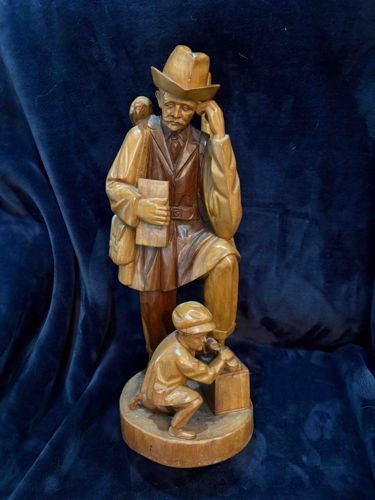
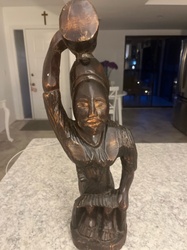
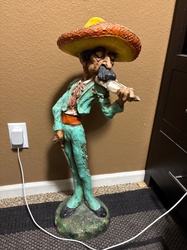
22 1/2 inch tall hand carved “Shoeshine Boy”. These were carved in Equador to raise money for the orphans who shined shoes in Quito.
These notes were written by the person who submitted this item. Appraiser.AI has not verified them, and the AI's identification and estimate may rely on them.
AI Estimated Value
Not an official valuation
$400-600
AI estimate as of June 23, 2025 · verify with a professional before acting
AI-Generated · Verify before acting
Everything on this page is generated by AI for informational purposes only. AI can make mistakes — the AI may misidentify items or misattribute them (artist, maker, brand, designer, origin, era). This is not an official valuation and should not be used for insurance, sale, tax, estate, legal, or lending purposes — or any decision requiring a certified appraisal. It is not an authoritative claim about any person, brand, or rights holder — do not share or rely on it as a factual statement about a third party. Always consult qualified professionals before making financial decisions.
This analysis also relies on unverified notes provided by the user, which may be incomplete or inaccurate and could affect the result.
This is a hand-carved wooden figural sculpture, identified as a "Shoeshine Boy" from Ecuador, likely created to support orphans in Quito. Standing 22 1/2 inches tall, the carving depicts two figures: an older gentleman receiving a shoeshine and a young boy performing the service. The piece is made from what appears to be a light-colored hardwood, possibly tropical, with variations in wood grain and color adding depth and character. The primary figure, the gentleman, is depicted with one knee raised, resting his hand on his head in a thoughtful or weary pose, while holding a book or tablet in his left hand. He wears a wide-brimmed hat, a collared shirt, and a vest over a jacket, with visible details carved for buttons and lapels. There's a subtle contrast in wood tone, suggesting either different wood types or staining to differentiate clothing elements. A small, indistinct animal figure, possibly a parrot or monkey, is perched on his left shoulder, adding a unique and playful element. The shoeshine boy is crouched low at the gentleman's foot, diligently working on a shoe, which is obscured by the shoeshine box. The boy is depicted in simple attire, with a cap. Both figures exhibit a rustic, folk-art style, characterized by simplified forms and expressive, though not hyper-realistic, detailing. The carving is robust, with visible tool marks contributing to its handcrafted appeal. The base is an integral part of the carving, a simple oval or circular platform. There are no obvious signs of significant damage such as large cracks or chips, indicating good preservation. The wood shows a natural patina consistent with its age and material, suggesting careful handling over time. The craftsmanship, while not finely detailed classical sculpture, is skilled in its ability to capture a narrative scene with emotion and character, reflecting traditional Ecuadorian wood carving techniques.
AI Appraisal Report
Based on my examination of the provided image and description, this Ecuadorian hand-carved "Shoeshine Boy" sculpture appears to be in very good condition. The wood shows a natural patina consistent with its age and material, with no obvious signs of significant damage like large cracks or chips. The visible tool marks affirm its handcrafted authenticity as a folk art piece. The narrative scene, depicting an older gentleman receiving a shoeshine from a young boy, is characteristic of Ecuadorian folk art, often made to support local causes, in this case, orphans in Quito. While I can assess its condition and stylistic authenticity from the image, a definitive authentication would require in-person examination to verify wood type, confirm tool marks, and check for any repairs or alterations not visible in photographs. Provenance documentation, such as records from its original purchase or acquisition in Ecuador, would significantly enhance its authenticity and value. Regarding market conditions, similar Ecuadorian folk art carvings, particularly those with a social narrative and good height (22 1/2 inches is substantial), typically find an appreciative niche market among collectors of Latin American art and folk art. The demand for well-preserved, larger pieces with a clear story is moderate but consistent. Its rarity is relative; while many such carvings exist, larger, undamaged examples with distinct character are less common. The "orphan support" backstory adds a layer of cultural significance, potentially increasing its appeal. Factors impacting value positively include its good condition, size, and the endearing narrative. The primary limitation in assessing value solely from images is the inability to fully inspect surface integrity, wood quality, and subtle details. Without physical inspection, I am unable to confirm that this is a unique piece, or if it is a part of a larger series.