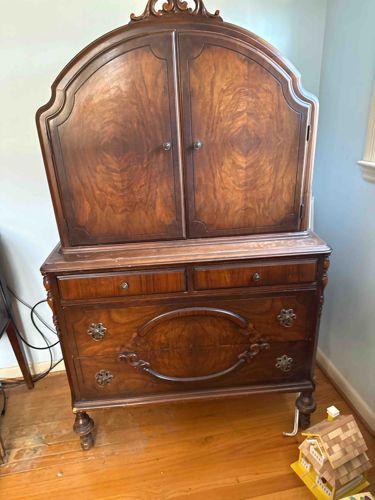
Early 20th Century Walnut Veneer Sideboard with Arched Hutch
Antique Furniture

Early 20th Century Walnut Veneer Sideboard with Arched Hutch

This piece of furniture is a two-piece sideboard or buffet set in a transitional style, likely dating from the 1920s to 1940s. It features a top hutch section distinguished by a high, bell-shaped arch and book-matched walnut burl veneers on the double doors, topped with a scrolled decorative crest. The base consists of two shallow drawers over two large, deep drawers. The large lower drawers are unified by a central oval medallion with carved foliate flourishes and floral-shaped metal pull handles. The construction showcases typical Revival-era craftsmanship, utilizing figured walnut veneers over a secondary wood frame. The legs are turned in a bulbous, trumpet-like fashion with integrated casters. Condition-wise, the piece shows significant signs of age and use: there is visible surface wear, scratches, and finish loss along the horizontal shelf of the base and on the feet. The patina is uneven, particularly on the base where dust and moisture may have affected the varnish. No maker's mark is visible from the exterior, but the style is characteristic of American mass-produced fine furniture from the Depression era.
Estimated Value

$450 - $700

Basic Information

Category

Antique Furniture

Appraised On

January 20, 2026

Estimated Value

$450 - $700

Item Description

This piece of furniture is a two-piece sideboard or buffet set in a transitional style, likely dating from the 1920s to 1940s. It features a top hutch section distinguished by a high, bell-shaped arch and book-matched walnut burl veneers on the double doors, topped with a scrolled decorative crest. The base consists of two shallow drawers over two large, deep drawers. The large lower drawers are unified by a central oval medallion with carved foliate flourishes and floral-shaped metal pull handles. The construction showcases typical Revival-era craftsmanship, utilizing figured walnut veneers over a secondary wood frame. The legs are turned in a bulbous, trumpet-like fashion with integrated casters. Condition-wise, the piece shows significant signs of age and use: there is visible surface wear, scratches, and finish loss along the horizontal shelf of the base and on the feet. The patina is uneven, particularly on the base where dust and moisture may have affected the varnish. No maker's mark is visible from the exterior, but the style is characteristic of American mass-produced fine furniture from the Depression era.
Get Your Items Appraised

Instant estimates of your treasures with AI-powered instant appraisals

Browse More Appraisals