AI Appraisal Estimate

AI-generated estimates · not official valuations

From the user

What was submitted

Photo and notes provided by the user — not generated by AI

Submitted item photo
Submitted photo · June 6, 2026

User's notes

No additional notes provided.

AI analysis below

AI appraisal

AI analysis & estimate

AI-Generated · Verify before acting

Everything below is generated by AI for informational purposes only. AI can make mistakes — the AI may misidentify items or misattribute them (artist, maker, brand, designer, origin, era). This is not an official valuation and should not be used for insurance, sale, tax, estate, legal, or lending purposes — or any decision requiring a certified appraisal. It is not an authoritative claim about any person, brand, or rights holder — do not share or rely on it as a factual statement about a third party. Always consult qualified professionals before making financial decisions.

Read the full disclaimer

AI Identification

·Not independently authenticated·Verify before acting

Ceramic Foo Dog/Lion-Dog Figurine

Decorative Arts

AI Estimated Value

·Not an official valuation·Verify before acting

$150-250

As of June 6, 2026

AI Item Analysis

·AI can make mistakes·Verify before acting
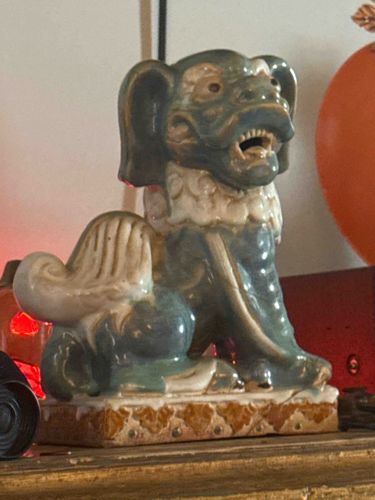
This item is a ceramic figurine depicting a stylized Foo Dog or Lion-Dog, commonly found in East Asian art and architecture. The figurine is rendered in a seated pose, with its head turned slightly to the viewer's right, and its mouth open as if roaring or snarling, revealing small teeth. The primary color scheme consists of a muted, grayish-blue glaze covering the body, contrasted with areas of creamy white or ivory glaze on the mane, paws, and parts of the tail. The base of the figurine is a rectangular plinth with a patterned design, possibly a geometric or repeating motif, glazed in a warm, yellowish-brown or ochre color, and outlined in white. The eyes are distinct and outlined, adding an expressive quality to the face. The construction appears to be solid ceramic, likely earthenware or stoneware, finished with a glossy glaze. There are visible signs of age and wear, particularly on the base where the glaze shows some chipping or loss, exposing the lighter ceramic body underneath. The intricate details of the mane and tail are sculpted with precision, suggesting a degree of craftsmanship. The overall style points to a traditional East Asian aesthetic, possibly from the 20th century. No obvious maker's marks or signatures are visible from the provided images, which would typically be found on the underside of the base. The 'roar' position of the mouth is a common characteristic of 'guardian' figures, intended to ward off evil.
AI Appraisal Report

·AI can make mistakes·Verify before acting
Based on my visual examination of the provided image, this ceramic Foo Dog or Lion-Dog figurine appears to be a decorative item consistent with East Asian aesthetics, likely dating from the 20th century. The condition shows visible signs of age and wear, particularly chipping and glaze loss on the rectangular base, exposing the lighter ceramic body beneath. This wear is commensurate with typical handling and age for such an object. The open-mouthed, 'roaring' posture is characteristic of guardian figures, intended to ward off negative influences. Authenticity, in terms of period and origin, is difficult to definitively confirm from images alone. While the style is traditional, many such items were mass-produced. A thorough in-person examination would be crucial to assess the quality of the ceramic body, the consistency of the glaze application, and potential manufacturer's marks or signatures, which are not visible here. Without physical inspection, I cannot verify if this is a genuine antique or a more recent decorative reproduction. Market conditions for such decorative Foo Dog figurines are generally moderate. While demand exists, particularly for well-preserved or exceptionally crafted examples, the market is saturated with similar items. Rarity is not a significant factor here; these figures were produced in considerable numbers. The lack of distinct maker's marks or provenance documentation significantly impacts its value, positioning it more as a decorative object than a collectible antique. Factors reducing value include the visible wear and the absence of any unique features or provenance. For full authentication and a more precise valuation, I would require an in-hand inspection to assess the ceramic's body, glaze texture, and manufacturing techniques. Further research into similar examples with confirmed origins would also be beneficial.

Get your items appraised

Instant estimates of your treasures with AI-powered appraisals

Browse More Appraisals