AI Appraisal Estimate

AI-generated estimates · not official valuations

From the user

What was submitted

Photo and notes provided by the user — not generated by AI

Submitted item photo
Submitted photo · June 6, 2026

User's notes

Coins

AI analysis below

AI appraisal

AI analysis & estimate

AI-Generated · Verify before acting

Everything below is generated by AI for informational purposes only. AI can make mistakes — the AI may misidentify items or misattribute them (artist, maker, brand, designer, origin, era). This is not an official valuation and should not be used for insurance, sale, tax, estate, legal, or lending purposes — or any decision requiring a certified appraisal. It is not an authoritative claim about any person, brand, or rights holder — do not share or rely on it as a factual statement about a third party. Always consult qualified professionals before making financial decisions.

Note

This analysis also relies on unverified notes provided by the user, which may be incomplete or inaccurate and could affect the result.

Read the full disclaimer

AI Identification

·Not independently authenticated·Verify before acting

Historical European Coins: Swiss 1 Rappen (1861) and Belgian 10 Centimes (1923)

Numismatics / World Coins

AI Estimated Value

·Not an official valuation·Verify before acting

$12.00 - $18.00

As of June 6, 2026

AI Item Analysis

·AI can make mistakes·Verify before acting
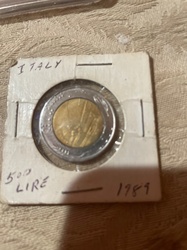
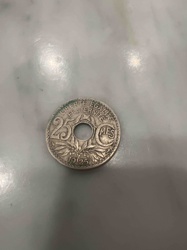
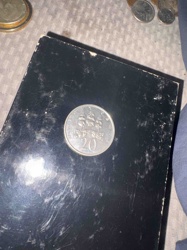
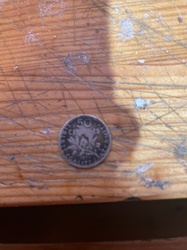
This pair of vintage European coins consists of a Swiss 1 Rappen and a Belgian 10 Centimes piece. The first coin is a 1861-B Swiss Rappen, struck in bronze (copper/tin/zinc). It features the numeral '1' over the date '1861' and the Bern 'B' mint mark, enclosed within a circular oak wreath. The second coin is a 1923 Belgian 10 Centimes, identifiable by its iconic central hole. This holed variety is made of Cupro-nickel and features the French legend 'ROYAUME DE BELGIQUE' with the date '1923' and a crowned royal monogram of King Albert I (intertwined 'A'). Both coins exhibit a rich, darkened circulation patina with significant surface oxidation; the 1861 Rappen shows a brownish-orange copper tone while the 1923 piece has a greyish metallic tarnish typical of aged nickel alloys. Wear is evident on the relief details and rims, indicating they were heavily circulated currency from the late 19th and early 20th centuries. There are no significant gouges, but the softening of the lettering suggests a grade of approximately Good to Very Good (G/VG) for the Swiss piece and Fine (F) for the Belgian piece.
AI Appraisal Report

·AI can make mistakes·Verify before acting
I have examined the Swiss 1 Rappen (1861-B) and the Belgian 10 Centimes (1923) through the provided documentation and visual details. The Swiss piece exhibits a heavy brownish-orange patina consistent with mid-19th-century bronze compositions, though the softening of the oak wreath and date suggests a grade of Good to Very Good (G/VG). The Belgian 10 Centimes, featuring the Albert I monogram and distinctive central hole, shows less overall wear and survives in Fine (F) condition with typical greyish cupro-nickel oxidation. Both pieces appear authentic based on die characteristics and common indicators of age-related wear. Market demand for mid-18th and early 20th-century base metal European coinage remains steady among entry-level numismatists. The 1861-B Swiss Rappen is a common date, with a mintage of roughly 2.3 million; it carries a modest premium as a Victorian-era bronze. The 1923 Belgian 10 Centimes is highly common, with over 15 million struck, and commands only nominal value despite its attractive hole design. Current retail comparables for this pair at these specific grades typically aggregate to $12–$18 USD. Limitations to this appraisal: A definitive determination of authenticity and grade cannot be made from images alone. In-person examination is required to verify the weight (1.0g for the Rappen; 3.0g for the 10 Centimes) and diameter to ensure they are not contemporary counterfeits or specimens with cleaned/restored surfaces. Scientific testing, such as X-ray fluorescence (XRF) to confirm metal alloy composition, would further validate the 1861 piece's bronze integrity.

Get your items appraised

Instant estimates of your treasures with AI-powered appraisals

Browse More Appraisals