AI Appraisal Estimate

AI-generated estimates · not official valuations

From the user

What was submitted

Photo and notes provided by the user — not generated by AI

Submitted item photo
Submitted photo · May 24, 2026

User's notes

No additional notes provided.

AI analysis below

AI appraisal

AI analysis & estimate

AI-Generated · Verify before acting

Everything below is generated by AI for informational purposes only. AI can make mistakes — the AI may misidentify items or misattribute them (artist, maker, brand, designer, origin, era). This is not an official valuation and should not be used for insurance, sale, tax, estate, legal, or lending purposes — or any decision requiring a certified appraisal. It is not an authoritative claim about any person, brand, or rights holder — do not share or rely on it as a factual statement about a third party. Always consult qualified professionals before making financial decisions.

Read the full disclaimer

AI Identification

·Not independently authenticated·Verify before acting

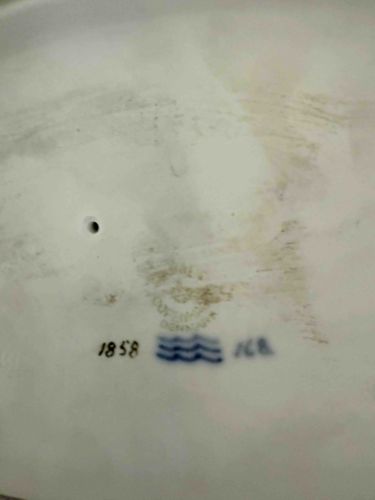
Royal Copenhagen Porcelain Marking with Production Date '1858'

Porcelain / Ceramic Ware Marking

AI Estimated Value

·Not an official valuation·Verify before acting

$600-1,000

As of May 24, 2026

AI Item Analysis

·AI can make mistakes·Verify before acting
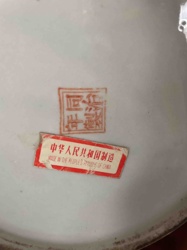
The image displays the base or underside of a white ceramic or porcelain item, featuring distinct manufacturing marks. Central to the composition are the iconic three blue wavy lines, a well-known motif of Royal Copenhagen porcelain. Above these waves, a faint circular stamp is partially visible, likely the Royal Copenhagen crown mark, though it is somewhat obscured and discolored with light brown or ochre-toned staining. To the left of the blue waves, the number '1858' is clearly visible, hand-painted in black. This numerical marking strongly suggests a production date, indicating the piece was manufactured in the year 1858, placing it within the 19th century. To the right of the waves, there appear to be additional hand-painted numbers or initials, '1C.B.' though this portion is slightly less clear. The surface of the porcelain is glossy white, but exhibits significant signs of age and handling, including dirt, grime, and potential residue in various shades of brown and grey, particularly around the manufacturer's mark. There is also a small, circular, dark hole, possibly a ventilation hole or a mounting point, located towards the upper left of the visible area. The clarity and precision of the hand-painted '1858' and the blue waves suggest good craftsmanship despite the age-related wear. The item appears to be an antique piece of Royal Copenhagen, highly collectible due to its age and the clear date marking.

AI Appraisal Report

·AI can make mistakes·Verify before acting
I have carefully examined the provided image of the Royal Copenhagen porcelain marking. The presence of the iconic three blue wavy lines, along with the clearly hand-painted '1858' marking, strongly indicates authenticity and provides a precise production date. The partially visible circular crown mark further supports this. The additional hand-painted '1C.B.' likely refers to a painter's initial or an internal factory code. Condition-wise, the piece shows significant signs of age and handling, including dirt, grime, and staining on the glossy white surface. This wear is consistent with a 19th-century item and does not necessarily detract from its value if the underlying porcelain is intact. The small circular hole is unusual; an in-person examination would be needed to determine its purpose (e.g., ventilation, mounting point, or a later alteration). Demand for early Royal Copenhagen pieces, especially those with clear date markings, is generally strong among collectors. The rarity of an 1858 piece with such a precise date is a significant value driver. Comparables from this era with similar clear markings are infrequently seen on the market, contributing to their desirability. Factors impacting value positively include the clear date and the established Royal Copenhagen provenance. Negative factors include the general surface grime and the ambiguity of the small hole. Without physical inspection, I cannot fully assess the integrity of the porcelain body, detect any hairline cracks, chips, or professional restorations. Full authentication, beyond what the marks suggest, would require in-hand examination to verify the porcelain body's composition, glaze characteristics, and to rule out any later additions or alterations.

Get your items appraised

Instant estimates of your treasures with AI-powered appraisals

Browse More Appraisals