Antique Aquatint or Hand-Colored Engraving of Sunnyside, Home of Washington Irving
Antique Art / Historical Prints

Antique Aquatint or Hand-Colored Engraving of Sunnyside, Home of Washington Irving

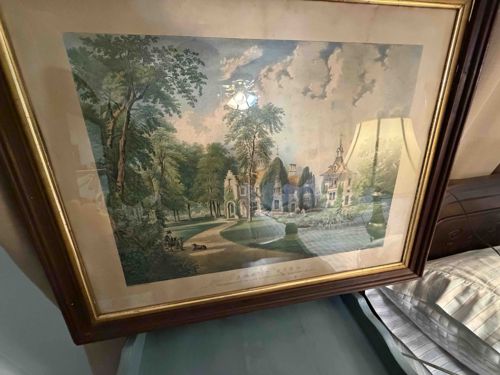
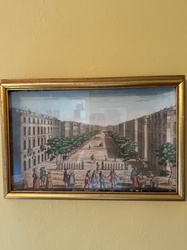
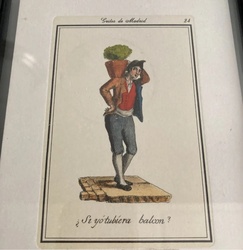
This is a framed antique print, appearing to be a mid-19th-century hand-colored lithograph or engraving depicting 'Sunnyside,' the iconic Gothic-revival cottage of author Washington Irving in Tarrytown, New York. The artwork features a soft palette of greens, blues, and earth tones, illustrating the manor's distinctive Dutch-stepped gables and architectural flair amidst a lush, wooded landscape. A winding path and a carriage are visible in the foreground, demonstrating classic Romantic era compositional techniques. The print glass shows a strong reflection from a nearby lamp, but the underlying paper exhibits visible toning (browning) consistent with age, particularly along the margins. The piece is housed in a traditional wood frame with a narrow gilded inner fillet and a wide, possibly silk-wrapped or paper-textured mat. The frame shows some minor surface scuffing but remains structurally sound. There is a title line below the image, likely indicating the publisher and city, which was a standard for mid-Victorian era topographic prints produced by firms like Currier & Ives or similar high-quality printmakers of the 1850s-1870s.
Estimated Value

$250 - $450

Basic Information

Category

Antique Art / Historical Prints

Appraised On

March 16, 2026

Estimated Value

$250 - $450

Item Description

This is a framed antique print, appearing to be a mid-19th-century hand-colored lithograph or engraving depicting 'Sunnyside,' the iconic Gothic-revival cottage of author Washington Irving in Tarrytown, New York. The artwork features a soft palette of greens, blues, and earth tones, illustrating the manor's distinctive Dutch-stepped gables and architectural flair amidst a lush, wooded landscape. A winding path and a carriage are visible in the foreground, demonstrating classic Romantic era compositional techniques. The print glass shows a strong reflection from a nearby lamp, but the underlying paper exhibits visible toning (browning) consistent with age, particularly along the margins. The piece is housed in a traditional wood frame with a narrow gilded inner fillet and a wide, possibly silk-wrapped or paper-textured mat. The frame shows some minor surface scuffing but remains structurally sound. There is a title line below the image, likely indicating the publisher and city, which was a standard for mid-Victorian era topographic prints produced by firms like Currier & Ives or similar high-quality printmakers of the 1850s-1870s.
Get Your Items Appraised

Instant estimates of your treasures with AI-powered instant appraisals

Browse More Appraisals