AI Appraisal Estimate

AI-generated estimates · not official valuations

From the user

What was submitted

Photo and notes provided by the user — not generated by AI

Submitted item photo
Submitted photo · June 3, 2026

User's notes

No additional notes provided.

AI analysis below

AI appraisal

AI analysis & estimate

AI-Generated · Verify before acting

Everything below is generated by AI for informational purposes only. AI can make mistakes — the AI may misidentify items or misattribute them (artist, maker, brand, designer, origin, era). This is not an official valuation and should not be used for insurance, sale, tax, estate, legal, or lending purposes — or any decision requiring a certified appraisal. It is not an authoritative claim about any person, brand, or rights holder — do not share or rely on it as a factual statement about a third party. Always consult qualified professionals before making financial decisions.

Read the full disclaimer

AI Identification

·Not independently authenticated·Verify before acting

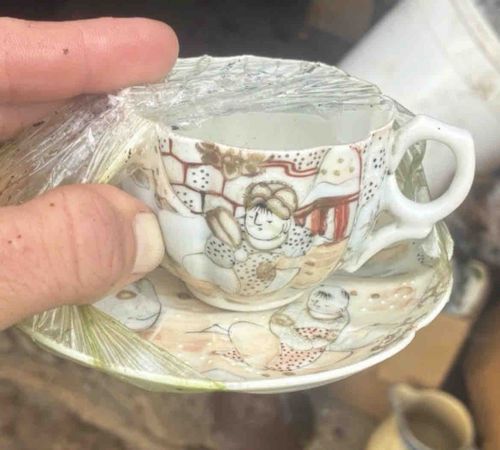
Japanese Satsuma Style Eggshell Porcelain Teacup and Saucer

Antique Japanese Ceramics / Porcelains

AI Estimated Value

·Not an official valuation·Verify before acting

$150-250

As of June 3, 2026

AI Item Analysis

·AI can make mistakes·Verify before acting
This is a small, hand-painted teacup and matching saucer set, likely of Japanese origin and executed in the Satsuma or Kutani style. The set is crafted from 'eggshell' porcelain, characterized by its extremely thin, translucent body. The exterior of the cup and the surface of the saucer are decorated with traditional figural motifs, depicting individuals in period dress amidst a background of geometric patterns and floral elements. The palette consists of iron-red, brown, and gold enamels against a pale cream-colored glaze. The cup features a lobed or scalloped rim and a distinctive d-shaped handle with a small protrusion at the base. Visible craftsmanship includes hand-painted line work and stenciled gold accents, typical of early 20th-century export ware from the Meiji or Taisho periods. Condition-wise, the cup shows some minor firing specks (freckling) in the porcelain body and slight wear to the gilt on the handle and rim. Currently, the item is secured with protective plastic film. The thinness of the walls and the delicate handle design indicate high-quality ceramic production aimed at the Western collector's market.
AI Appraisal Report

·AI can make mistakes·Verify before acting
I have conducted a visual inspection of this Japanese eggshell porcelain teacup and saucer. The set exhibits the characteristic 'Thousand Faces' or 'Immortal' motif, popularized during the late Meiji (1868–1912) and Taisho (1912–1926) periods. The use of moriage (raised enamel) and the iron-red and gold palette suggests it was produced for the Western export market, likely in the Kutani or Satsuma style. The translucency of the 'eggshell' walls remains high, and the presence of slight firing specks indicates a period-correct manufacturing process rather than modern mass-produced imitation. Condition-wise, the set appears structurally sound, though the visible thinning of the gold gilt on the handle and the scalloped rims slightly diminishes the value. The market for Japanese export porcelain is currently stable but specialized; collectors prioritize sets with 'Lithophanes' (hidden images in the base) and those with specific kiln marks (e.g., Dai Nippon). Items without a visible maker's mark generally fall into the mid-range of the collectible market. While this set is a fine example of Japanese craftsmanship, my assessment is limited by the digital nature of this examination. A definitive authentication would require an in-person inspection to verify the tactile texture of the enamels and a 'ring test' to check for hairline cracks. Provenance documentation or a visible signature on the base would be necessary to attribute this to a specific master kiln. Scientific testing, such as a thermoluminescence (TL) test, is generally not cost-effective for items of this value range but would be the only way to scientifically confirm the firing age.

Get your items appraised

Instant estimates of your treasures with AI-powered appraisals

Browse More Appraisals