These notes were written by the person who submitted this item. Appraiser.AI has not verified them, and the AI's identification and estimate may rely on them.
AI Estimated Value
Not an official valuation
$30-50
AI estimate as of August 21, 2025 · verify with a professional before acting
AI-Generated · Verify before acting
Everything on this page is generated by AI for informational purposes only. AI can make mistakes — the AI may misidentify items or misattribute them (artist, maker, brand, designer, origin, era). This is not an official valuation and should not be used for insurance, sale, tax, estate, legal, or lending purposes — or any decision requiring a certified appraisal. It is not an authoritative claim about any person, brand, or rights holder — do not share or rely on it as a factual statement about a third party. Always consult qualified professionals before making financial decisions.
This analysis also relies on unverified notes provided by the user, which may be incomplete or inaccurate and could affect the result.
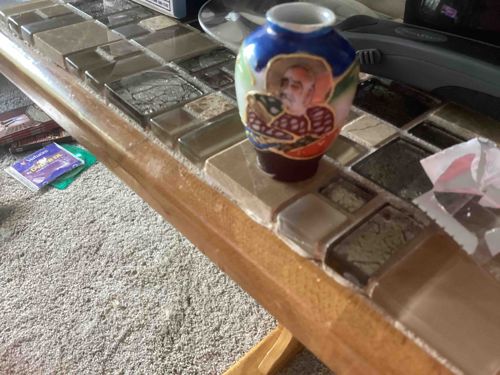
This is a small decorative ceramic vase, likely measuring approximately 3-4 inches in height. Its body is bell-shaped, tapering slightly towards the base and flaring gently at the rim. The primary colors of the glaze are a vibrant royal blue at the top and a rich burgundy at the bottom, transitioning to a softer pale green in the middle section. The vase features hand-painted decorations, most notably a portrait of a bearded man with a turban-like head covering, rendered in warm tones of peach, brown, and gold. Below the portrait, there's a detailed, patterned motif in reds, browns, and blacks, possibly depicting fabric or an intricate design. The top rim of the vase is white, suggesting an unglazed or simply white-glazed interior. The craftsmanship appears to be reasonably fine, with visible brushstrokes indicating hand-painting, though some minor imperfections or inconsistencies in the application of the glaze may be present, consistent with mass production. There are no readily visible cracks or chips, but without closer inspection, minor surface wear or crazing cannot be ruled out. Given the 'Made in Occupied Japan' context, this item dates from the period immediately following World War II, specifically 1945 to 1952. Items from this era and origin are characterized by their often elaborate, somewhat kitsch, decorative styles, frequently produced for export.
AI Appraisal Report
Upon examining the provided image and information regarding this 'Occupied Japan' hand-painted ceramic vase with figural decoration, I can offer the following appraisal. In terms of condition, from the visual evidence, the vase appears to be in reasonably good shape with no immediately visible chips or cracks. The hand-painted decoration, featuring a bearded man in a turban and intricate patterns, is intact. However, without a physical inspection, I cannot confirm the absence of minor surface wear, crazing, or subtle glaze inconsistencies that are common in mass-produced items of this era. Authenticity, based on the 'Made in Occupied Japan' context, is very likely, given the typical decorative style of that period (1945-1952) – often intricate, somewhat kitsch, and produced for export. However, definitive authentication would require an in-person examination to verify the mark's legitimacy, assess the ceramic body, and detect any restoration. Market conditions for 'Occupied Japan' ceramics are generally modest. While there's a collector base, it's not a highly sought-after collectible like fine art pottery. Comparables in the market for similar small, decorative vases from this period typically fetch prices in the lower to mid-range. Demand is niche; while individual pieces can be charming, they aren't rare enough to command high prices unless they possess exceptional artistic merit or unique characteristics. The hand-painted figural detail on this piece adds a degree of artistic interest beyond generic floral designs, which marginally enhances its appeal. Factors significantly impacting value for 'Occupied Japan' items include condition (any damage severely reduces value), uniqueness of the decoration, and sometimes, the specific manufacturer if identifiable. Overall, without physical examination to confirm condition and authenticity definitively, this appraisal relies solely on the visual information and stated historical context.