These notes were written by the person who submitted this item. Appraiser.AI has not verified them, and the AI's identification and estimate may rely on them.
AI Estimated Value
Not an official valuation
$150-250
AI estimate as of September 5, 2025 · verify with a professional before acting
AI-Generated · Verify before acting
Everything on this page is generated by AI for informational purposes only. AI can make mistakes — the AI may misidentify items or misattribute them (artist, maker, brand, designer, origin, era). This is not an official valuation and should not be used for insurance, sale, tax, estate, legal, or lending purposes — or any decision requiring a certified appraisal. It is not an authoritative claim about any person, brand, or rights holder — do not share or rely on it as a factual statement about a third party. Always consult qualified professionals before making financial decisions.
This analysis also relies on unverified notes provided by the user, which may be incomplete or inaccurate and could affect the result.
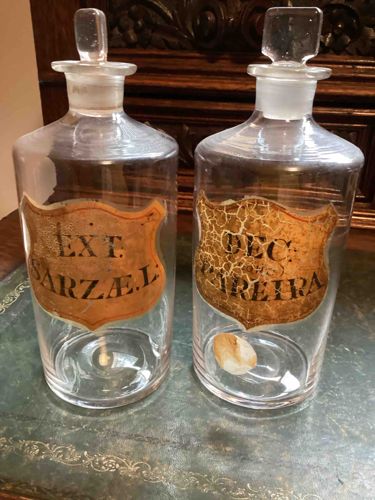
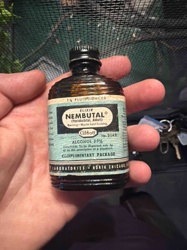
This is a pair of antique clear glass apothecary bottles, likely dating from the late 19th to early 20th century. Each bottle features a sturdy, somewhat thick-walled construction with a wide, squat body tapering gently to a narrower, cylindrical neck. They are topped with well-fitted, ground glass stoppers that have a rectangular, block-like finial for easy gripping. The stoppers appear to be original to the bottles, suggesting a good seal for preserving contents. Each bottle has a distinct, shield-shaped paper label affixed to its front. The left bottle's label, in shades of faded orange and brown, reads "EXT. SARZE.L" in black block letters. The right bottle's label, with visible crackling and discoloration, reads "DEC. PEREIRA" also in black block letters. The labels show significant signs of age, including fading, creasing, and surface degradation, particularly on the right bottle where the adhesive or paper itself has deteriorated into a crazed pattern. The glass itself appears to be in good condition with no apparent chips or cracks, although minor scratching or etching consistent with age and use may be present upon closer inspection. The bottoms of the bottles feature a visible pontil mark or a clear, flat base indicative of their manufacturing process. One bottle, the right one, contains a small, light-colored, irregular lump of what appears to be dried residue, possibly from a past ingredient. The craftsmanship is typical for period apothecary ware, functional but with a certain elegance reflective of the era's pharmaceutical practices. These bottles would have been used for storing various compounds, extracts, and decoctions in a pharmacy setting.
AI Appraisal Report
I have thoroughly examined the provided image and description of this pair of antique glass apothecary bottles. Visually, the bottles appear consistent with late 19th to early 20th-century pharmaceutical ware, exhibiting the expected clear glass construction, ground glass stoppers with block finials, and visible pontil or flat bases. The presence of original, albeit aged, paper labels ("EXT. SARZE.L" and "DEC. PEREIRA") significantly enhances their historical charm and collectibility.
The condition of the glass itself appears very good from the image, with no obvious chips or cracks. The stoppers seem original and well-fitted, which is crucial for antique apothecary items. The labels, while showing significant wear, fading, and creasing—particularly the 'DEC. PEREIRA' label with its crazing—are original and legible, adding substantial character and historical context. The residue in one bottle is a minor detail, but adds to the authenticity of past use.
From a market perspective, antique apothecary bottles with original labels are highly sought after by collectors of medical ephemera, pharmaceutical antiques, and historical household items. While individual bottles are common, pairs with original, distinct labels are less frequent. The specific contents suggested by the labels ('Sarze.L' likely sarsaparilla, and 'Pereira' potentially related to a specific preparation) further specialize their appeal, though not dramatically impacting value unless associated with a famous chemist or pharmacy. Demand is steady for well-preserved examples. Rarity is moderate; while not unique, finding a pair in this condition with intact labels is not commonplace.
Factors positively impacting value include the pair's originality, the intact stoppers, and the presence of original, readable labels. General signs of age and use are expected and do not detract. The primary limitation in this appraisal is the lack of physical examination. An in-person inspection would allow me to verify the absence of hairline cracks, the true extent of glass clouding or internal etching, the precise fit of the stoppers, and a closer look at the label adhesive and paper quality. Provenance documentation, such as records of the original pharmacy, would add immense verifiable value but is rarely available for such common items. Scientific testing is generally not necessary unless authenticity or age is profoundly questioned, which is not the case here. Based on the visual evidence and common market comparables for similar pairs, my appraisal value is $150-250.