Atwood’s Jaundice Bitters Bottle
Antique Glassware / Patent Medicine Bottles

Atwood’s Jaundice Bitters Bottle

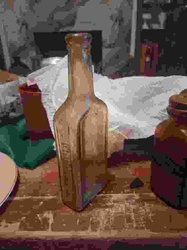
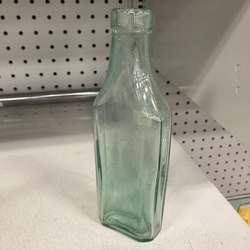
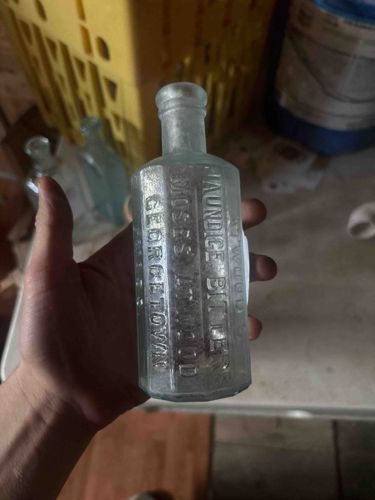
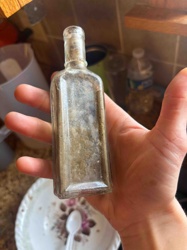
This is a vintage multi-sided (typically 12-sided) medicine bottle featuring heavy embossing on the vertical panels. The bottle is made of aqua-colored glass, a common hue for 19th-century utilitarian glassware. The central embossing prominently reads 'JAUNDICE BITTERS / MOSES ATWOOD / GEORGETOWN / MASS', identifying it as a patent medicine bottle from the mid-to-late 1800s. Physically, the bottle has a cylindrical flanged or 'doubled' lip finish and a short neck transitioning into a broad, paneled body. The glass shows characteristic manufacturing traits of the era, including small air bubbles (seeds) and slight surface irregularities. Regarding condition, the bottle appears to have significant internal 'sickness' or cloudiness, known as devitrification or mineralization, caused by long-term burial or fluid remnants reacting with the glass. This gray, hazy patina obscures the natural transparency of the aqua glass but is common in excavated specimens. There are no large cracks or chips immediately visible in the image, though the edges of the embossed letters show minor wear consistent with age. This specific style of bottle, attributed to Moses Atwood, dates approximately between 1855 and 1880, representing a classic era of American patent medicines.
Estimated Value

$15 - $35

Basic Information

Category

Antique Glassware / Patent Medicine Bottles

Appraised On

March 18, 2026

Estimated Value

$15 - $35

Item Description

This is a vintage multi-sided (typically 12-sided) medicine bottle featuring heavy embossing on the vertical panels. The bottle is made of aqua-colored glass, a common hue for 19th-century utilitarian glassware. The central embossing prominently reads 'JAUNDICE BITTERS / MOSES ATWOOD / GEORGETOWN / MASS', identifying it as a patent medicine bottle from the mid-to-late 1800s. Physically, the bottle has a cylindrical flanged or 'doubled' lip finish and a short neck transitioning into a broad, paneled body. The glass shows characteristic manufacturing traits of the era, including small air bubbles (seeds) and slight surface irregularities. Regarding condition, the bottle appears to have significant internal 'sickness' or cloudiness, known as devitrification or mineralization, caused by long-term burial or fluid remnants reacting with the glass. This gray, hazy patina obscures the natural transparency of the aqua glass but is common in excavated specimens. There are no large cracks or chips immediately visible in the image, though the edges of the embossed letters show minor wear consistent with age. This specific style of bottle, attributed to Moses Atwood, dates approximately between 1855 and 1880, representing a classic era of American patent medicines.
Get Your Items Appraised

Instant estimates of your treasures with AI-powered instant appraisals

Browse More Appraisals