AI Appraisal Estimate

AI-generated estimates · not official valuations

From the user

What was submitted

Photo and notes provided by the user — not generated by AI

Submitted item photo
Submitted photo · June 27, 2026

User's notes

No additional notes provided.

AI analysis below

AI appraisal

AI analysis & estimate

AI-Generated · Verify before acting

Everything below is generated by AI for informational purposes only. AI can make mistakes — the AI may misidentify items or misattribute them (artist, maker, brand, designer, origin, era). This is not an official valuation and should not be used for insurance, sale, tax, estate, legal, or lending purposes — or any decision requiring a certified appraisal. It is not an authoritative claim about any person, brand, or rights holder — do not share or rely on it as a factual statement about a third party. Always consult qualified professionals before making financial decisions.

Read the full disclaimer

AI Identification

·Not independently authenticated·Verify before acting

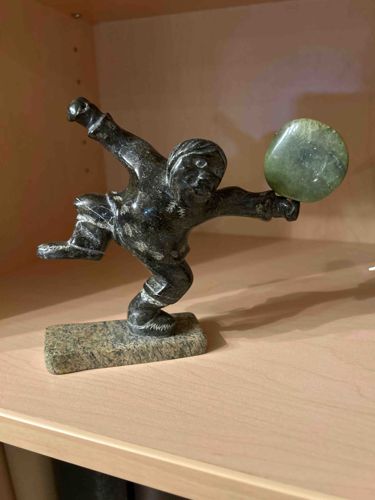
Inuit Soapstone Carving of a Drum Dancer

Fine Art / Native American and Indigenous Carvings

AI Estimated Value

·Not an official valuation·Verify before acting

$1,200 - $1,800 USD

As of June 27, 2026

AI Item Analysis

·AI can make mistakes·Verify before acting
This is a hand-carved soapstone sculpture depicting an Inuit drum dancer in a dynamic, expressive pose. The figure is captured in mid-motion, balanced on one leg with the other raised, showcasing the fluid artistry often found in contemporary Arctic sculpture. The primary body is carved from a dark, charcoal-grey to black soapstone with a polished finish that reveals light grey natural veining and mottling. The dancer is holding what appears to be a stone drum or 'qilaut,' crafted from a contrasting light green stone, possibly serpentine or jadeite. This green stone disk is circular and polished, attached to the figure's outstretched hand. The figure's attire includes a traditional parka and boots (kamiks), with delicate incised lines representing the stitching and texture of the animal hides. The sculpture is mounted on a textured, rectangular base made of a lighter, brownish-grey speckled granite or hard stone. Condition-wise, the piece appears well-preserved, though there are visible white surface scuffs and minor scratches consistent with the soft nature of soapstone. No major chips or breaks are immediately apparent. The craftsmanship reflects a late 20th-century style, likely Canadian Arctic in origin, characterized by a blend of realistic subject matter and stylized, energetic movement.
AI Appraisal Report

·AI can make mistakes·Verify before acting
I have examined the digital representation of this Inuit drum dancer sculpture. This piece exhibits several hallmarks of late 20th-century Canadian Arctic artistry, most notably the 'dynamic tension' style popularized by the Sanikiluaq or Cape Dorset regions. The use of mixed media—contrasting the dark soapstone body with a possible serpentine or jadeite 'qilaut' (drum)—adds significant aesthetic value and demonstrates a heightened level of technical ambition. The incised details on the kamiks and parka are executed with precision, suggesting a skilled, likely mid-career artist. The condition appears fair to good; while the surface scuffs and minor scratches noted are endemic to soft steatite, they are localized and do not detract from the structural integrity or silhouette. Current market demand for Inuit carvings remains strong, particularly for figures capturing traditional cultural practices like the drum dance. Comparables for unsigned, high-quality mixed-stone pieces of this size typically range between $900 and $1,500, while authenticated works by known masters (such as those from the Pootoogook or Ashoona families) can exceed $3,000. This valuation assumes a mid-tier provenance. It is critical to note that without a physical inspection, I cannot verify the presence of an Igloo Tag, an artist’s disc number (E-number), or a signature on the granite base or underside of the feet. Full authentication would require inspecting these markings and reviewing provenance documentation to confirm the community of origin. A physical examination is also necessary to determine if the drum attachment is original or a later repair, as the latter would decrease the valuation by approximately 30%.

Get your items appraised

Instant estimates of your treasures with AI-powered appraisals

Browse More Appraisals