Victorian Gaudy Welsh / Flow Blue Style Chinoiserie Ironstone Pitcher
Antique Ceramics and Pottery

Victorian Gaudy Welsh / Flow Blue Style Chinoiserie Ironstone Pitcher

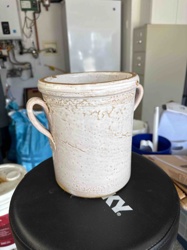
This is a small, hand-painted ironstone or porcelain pitcher featuring a bulbous body and a highly ornate scalloped rim and handle. The vessel is decorated in a Chinoiserie or 'Gaudy Welsh' style, common in the mid-to-late 19th century. The central motif depicts a stylized pagoda or gazebo in cobalt blue, accented with hand-applied orange (iron red) and green floral enamels, often referred to as a 'pagoda' or 'pavilion' pattern. Gold luster or gilt highlights are visible on the roof of the pagoda and throughout the foliage, indicating a higher quality of manufacture. The body is formed with moulded rococo-style relief work near the spout and base, which rests on a pedestal-style foot with scalloped edges. Physically, the piece shows signs of age-related wear including slight rubbing to the gold gilding on the handle and rim. There is visible 'crazing' (fine surface cracks in the glaze) and some slight staining near the foot, which is typical for earthenware and ironstone of this period. The handle is intricately molded with floral and leaf-like scrollwork. This piece likely dates from the 1850s to 1880s and represents the Victorian fascination with Orientalist aesthetics. The weight and glaze consistency suggest it is a durable ironstone rather than fine translucent porcelain.
Estimated Value

$65 - $125

Basic Information

Category

Antique Ceramics and Pottery

Appraised On

December 20, 2025

Estimated Value

$65 - $125

Item Description

This is a small, hand-painted ironstone or porcelain pitcher featuring a bulbous body and a highly ornate scalloped rim and handle. The vessel is decorated in a Chinoiserie or 'Gaudy Welsh' style, common in the mid-to-late 19th century. The central motif depicts a stylized pagoda or gazebo in cobalt blue, accented with hand-applied orange (iron red) and green floral enamels, often referred to as a 'pagoda' or 'pavilion' pattern. Gold luster or gilt highlights are visible on the roof of the pagoda and throughout the foliage, indicating a higher quality of manufacture. The body is formed with moulded rococo-style relief work near the spout and base, which rests on a pedestal-style foot with scalloped edges. Physically, the piece shows signs of age-related wear including slight rubbing to the gold gilding on the handle and rim. There is visible 'crazing' (fine surface cracks in the glaze) and some slight staining near the foot, which is typical for earthenware and ironstone of this period. The handle is intricately molded with floral and leaf-like scrollwork. This piece likely dates from the 1850s to 1880s and represents the Victorian fascination with Orientalist aesthetics. The weight and glaze consistency suggest it is a durable ironstone rather than fine translucent porcelain.
Get Your Items Appraised

Instant estimates of your treasures with AI-powered instant appraisals

Browse More Appraisals