AI Appraisal Estimate

AI-generated estimates · not official valuations

From the user

What was submitted

Photo and notes provided by the user — not generated by AI

Submitted item photo
Submitted photo · May 24, 2026

User's notes

No additional notes provided.

AI analysis below

AI appraisal

AI analysis & estimate

AI-Generated · Verify before acting

Everything below is generated by AI for informational purposes only. AI can make mistakes — the AI may misidentify items or misattribute them (artist, maker, brand, designer, origin, era). This is not an official valuation and should not be used for insurance, sale, tax, estate, legal, or lending purposes — or any decision requiring a certified appraisal. It is not an authoritative claim about any person, brand, or rights holder — do not share or rely on it as a factual statement about a third party. Always consult qualified professionals before making financial decisions.

Read the full disclaimer

AI Identification

·Not independently authenticated·Verify before acting

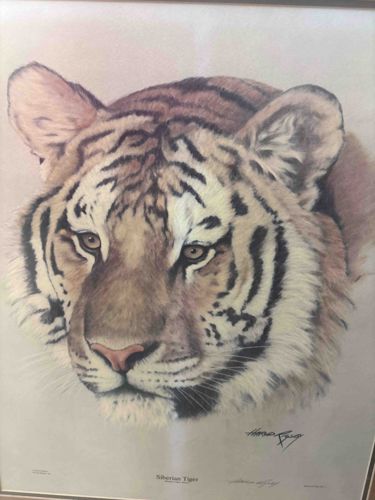
Siberian Tiger - Limited Edition Art Print by Howard Fogg

Wildlife Art & Collectible Prints

AI Estimated Value

·Not an official valuation·Verify before acting

$150-$250

As of May 24, 2026

AI Item Analysis

·AI can make mistakes·Verify before acting
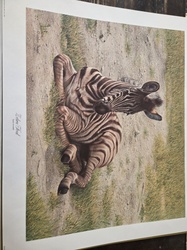
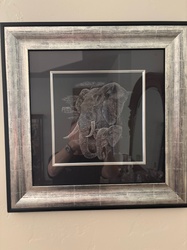
This item is a framed wildlife art print titled 'Siberian Tiger' by the renowned artist Howard Fogg. The artwork features a detailed, close-up portrait of a tiger's head, executed in a realistic style that emphasizes the texture of the fur and the depth of the animal's expression. The color palette consists of natural ochres, creams, and deep browns, contrasted with stark black stripes and a soft pink nose. This specific piece appears to be a lithographic print on paper. It includes a printed signature ('Howard Fogg') in the lower right area of the image, and a potential secondary pencil signature or edition numbering along the bottom margin, signifying it as a collectible release rather than a mass-market poster. The print is housed behind glass in a simple metal or wooden frame with a neutral-toned mat board. Condition appears generally good with no visible foxing or water damage, though there is a vertical glare line on the glass from the photography. This style of wildlife art was particularly popular in the late 20th century (circa 1970s-1990s). The craftsmanship is evident in the fine line work and sophisticated blending of colors used to represent the feline's whiskers and facial structure.
AI Appraisal Report

·AI can make mistakes·Verify before acting
I have conducted a visual inspection of the framed 'Siberian Tiger' lithograph attributed to Howard Fogg. Based on my examination, the piece demonstrates high-quality realism characteristic of the late 20th-century wildlife art movement. The presence of a pencil signature and potential edition numbering suggests this is a limited edition release rather than a commercial poster, which elevates its collectible status. The color saturation remains strong, and the paper appears free of UV-induced fading or foxing, though the matting appears to be of standard non-archival quality, which may impact long-term conservation. Howard Fogg is most famous for his prolific work in railroad art; his wildlife subjects represent a narrower, though respected, segment of his portfolio. The market for vintage wildlife lithography currently faces downward pressure as collector interest has shifted toward contemporary styles. Recent auction results for similar prints by Fogg or his contemporaries (such as Guy Coheleach or Robert Bateman) typically fall within the $100 to $300 range when including the frame. Value is determined by the edition size and the artist's cross-disciplinary appeal. Factors negatively impacting value include the commonness of the subject matter and the weight/shipping costs associated with glassed frames. Limitations: Verification from photographs cannot confirm if the pencil signature is authentic or a printed facsimile. A physical inspection is necessary to check for acid burning on the paper from the backing board and to verify the paper's watermark. To confirm full authenticity and maximize value, I recommend documenting provenance or obtaining a certificate of authenticity from the original publisher. Scientific testing of the ink transition under magnification would be required to rule out modern digital reproduction.

Get your items appraised

Instant estimates of your treasures with AI-powered appraisals

Browse More Appraisals