AI estimate as of July 10, 2025 · verify with a professional before acting
AI-Generated · Verify before acting
Everything on this page is generated by AI for informational purposes only. AI can make mistakes — the AI may misidentify items or misattribute them (artist, maker, brand, designer, origin, era). This is not an official valuation and should not be used for insurance, sale, tax, estate, legal, or lending purposes — or any decision requiring a certified appraisal. It is not an authoritative claim about any person, brand, or rights holder — do not share or rely on it as a factual statement about a third party. Always consult qualified professionals before making financial decisions.
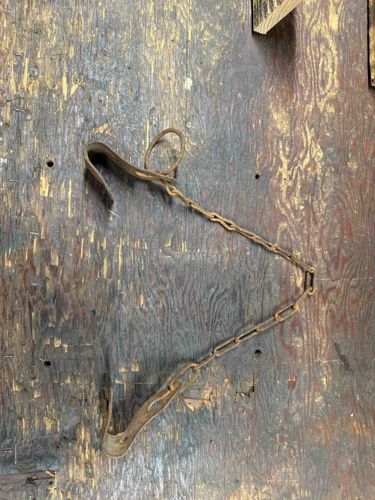
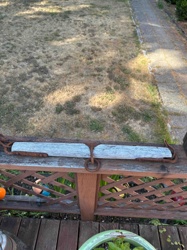
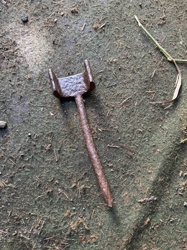
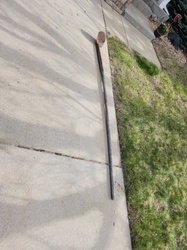
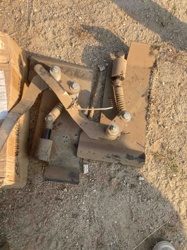
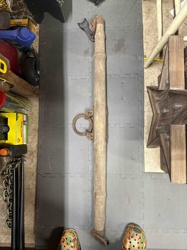
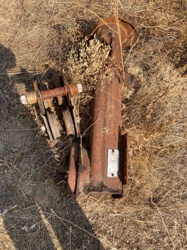
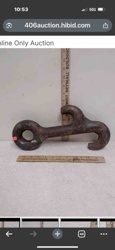
This item appears to be an antique or vintage hay hook (also known as a hay bale hook or silage fork). It is constructed primarily of iron or steel, as suggested by its dark, oxidized surface and sturdy appearance. The hook features a U-shaped or slightly curved handle section at one end, designed presumably for ergonomic gripping, which transitions into a straight, thick shaft. Attached to the handle by a loop or ring is a length of heavy-duty chain, composed of interconnected oval or elongated links. The overall coloration is a dark, rustic brown with significant reddish-brown oxidation, indicating extensive exposure to elements and age. There are no visible maker's marks or specific identifying stamps in the provided image. The rough texture around the chain attachment point and the overall robust, no-frills construction suggest a utility-focused design common in early to mid-20th-century farm tools. The condition shows considerable wear, consistent with prolonged use and age, including surface rust throughout the metal components, particularly on the chain links and the hook itself. Despite the rust, the fundamental structure appears intact, indicating decent craftsmanship for its intended heavy-duty application. The chain itself is approximately half to two-thirds the length of the hook, terminating without any discernable attachment mechanism at the end visible in the image. This tool's design strongly suggests its use for pulling or moving hay bales, feed sacks, or similar bulky items, allowing for leverage and a secure grasp. The 'patina' of rust and wear is indicative of its historical function and likely dates it to the early-to-mid 1900s, possibly earlier given the manual nature of the tool and absence of modern materials or finishes.
AI Appraisal Report
Upon my virtual examination of this Antique Hay Hook with Chain, I assess its authenticity as a genuine agricultural tool from the early to mid-20th century, consistent with the construction methods and material patina of that era. The robust iron/steel construction, U-shaped handle, and heavy-duty chain are typical of hay hooks designed for manual farm labor. The extensive surface rust and wear are indicative of prolonged use and exposure, supporting its vintage attribution rather than suggesting a modern reproduction. While its condition shows considerable surface oxidation, its fundamental structure appears sound, which is crucial for antique tools of this function.
In the current market for antique farm implements, items like this hay hook are generally valued for their historical charm, rustic aesthetics, and decorative potential rather than their functional utility. Comparables in online marketplaces and antique shops typically range from $20 to $60 depending on condition, uniqueness, and seller. While not exceedingly rare, tools from this period are becoming less common, contributing to a niche demand among collectors of Americana, rustic décor enthusiasts, or those preserving agricultural history. Factors impacting value include the visible wear, absence of maker's marks, which would enhance collector interest, and the utilitarian nature.
My assessment of authenticity is based solely on visual cues from the provided image. A full in-person examination would be necessary to confirm material composition, assess structural integrity more thoroughly, and search for faint, obscured maker's marks. Provenance documentation, though unlikely for such a common tool, would offer definitive authentication against potential fakes or modern reissues, but this is less critical for an item of this value.