AI Appraisal Estimate

AI-generated estimates · not official valuations

From the user

What was submitted

Photo and notes provided by the user — not generated by AI

Submitted item photo
Submitted photo · June 9, 2026

User's notes

No additional notes provided.

AI analysis below

AI appraisal

AI analysis & estimate

AI-Generated · Verify before acting

Everything below is generated by AI for informational purposes only. AI can make mistakes — the AI may misidentify items or misattribute them (artist, maker, brand, designer, origin, era). This is not an official valuation and should not be used for insurance, sale, tax, estate, legal, or lending purposes — or any decision requiring a certified appraisal. It is not an authoritative claim about any person, brand, or rights holder — do not share or rely on it as a factual statement about a third party. Always consult qualified professionals before making financial decisions.

Read the full disclaimer

AI Identification

·Not independently authenticated·Verify before acting

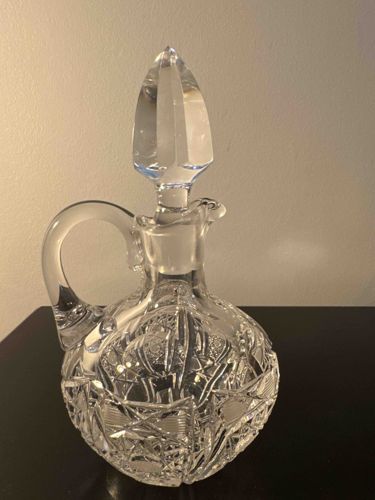
American Brilliant Period Cut Glass Cruet with Stopper

Antique Glassware / American Brilliant Period Cut Glass

AI Estimated Value

·Not an official valuation·Verify before acting

$125 - $175

As of June 9, 2026

AI Item Analysis

·AI can make mistakes·Verify before acting
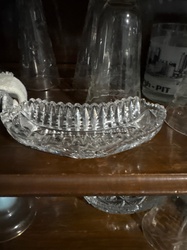
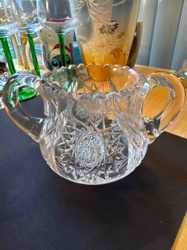
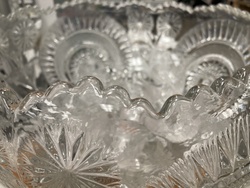
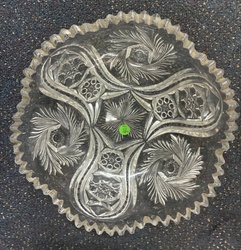
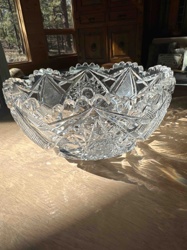
This is a hand-cut crystal vinegar or oil cruet dating from the American Brilliant Period (approx. 1876-1917). The piece features a globular body intricately decorated with classic deep-cut geometric motifs, including multi-point hobstar patterns, cross-hatching, and fan cuts. The vessel is constructed from heavy, high-lead content clear glass, which is evident by its high refractive index and clarity. It features an applied smooth 'C' shaped handle and a small pouring spout at the rim. The stopper is a faceted teardrop or flame shape with a ground base to ensure a tight fit within the neck. The craftsmanship is of high quality, characterized by sharp, crisp edges and complex intersections of the cut patterns. Regarding condition, the glass appears structurally sound with no visible cracks; however, typical for its age, there may be minor flea bites or microscopic nipping along the sharpest edges of the cut patterns and base. The base of the stopper shows typical signs of wear from insertion into the neck. No specific maker’s marks are visible in the image, but the style is consistent with prominent manufacturers of the era such as Libbey, Hoare, or Hawkes.
AI Appraisal Report

·AI can make mistakes·Verify before acting
Based on my visual examination of this American Brilliant Period (ABP) cut glass cruet, the piece exhibits the characteristic 'water-white' clarity and high refractive index associated with heavy leaded crystal from the 1876–1917 era. The intricate hobstar and fan motifs appear deeply mitre-cut with sharp, 'toothy' edges, indicating manual craftsmanship rather than inferior pressed-glass imitations. The hand-applied handle and faceted stopper are consistent with high-standard production methods of the period. The current market for ABP glass is steady but selective. While collectors value the complexity of the cutting, small utilitarian items like cruets are more common than large specialty pieces (e.g., punch bowls or floriform vases). The lack of a visible etched signature (such as Libbey or Hawkes) places this in the 'attributed' category, which slightly limits the ceiling price. I have accounted for minor 'flea bites' expected on sharp intersections, which are acceptable to most collectors but prevent a 'mint' valuation. Limitations: Verification of authenticity from digital images alone is restricted. A physical examination is required to confirm the 'ring' of the leaded glass, check for the presence of natural 'gray' or 'pink' tints under UV light, and look for specific 'wood-wheel' polishing marks. Because makers' marks are often faint or polished away, provenance documentation or a catalog match would be necessary to attribute this definitively to a specific house like Hoare or Dorflinger. Absence of internal 'sick' glass (cloudiness from vinegar acidity) would need to be confirmed in person to maintain the maximum value.

Get your items appraised

Instant estimates of your treasures with AI-powered appraisals

Browse More Appraisals