AI estimate as of October 27, 2025 · verify with a professional before acting
AI-Generated · Verify before acting
Everything on this page is generated by AI for informational purposes only. AI can make mistakes — the AI may misidentify items or misattribute them (artist, maker, brand, designer, origin, era). This is not an official valuation and should not be used for insurance, sale, tax, estate, legal, or lending purposes — or any decision requiring a certified appraisal. It is not an authoritative claim about any person, brand, or rights holder — do not share or rely on it as a factual statement about a third party. Always consult qualified professionals before making financial decisions.
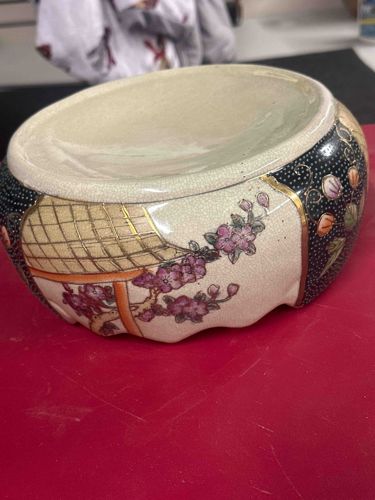
This item is a decorative covered bowl, appearing to be crafted from ceramic or porcelain with a distinctive Satsuma-style aesthetic. Its approximate dimensions are difficult to ascertain without a reference scale, but it appears to be a medium-sized piece, likely suitable for a trinket box, incense burner, or a small decorative dish. The bowl features a creamy off-white base color, heavily decorated with intricate hand-painted designs. The top surface of the lid is a plain, slightly concaved off-white, suggesting it might serve as a shallow dish itself or accommodate another small item. The sides of the bowl are segmented into panels, adorned with various motifs. One prominent panel showcases a trellis-like pattern in gold against a pale yellow background, possibly representing a woven screen or part of a building. Adjacent to this, a panel features vibrant pink and purple blossoms on branches, indicative of plum blossoms or cherry blossoms, rendered with fine detail. Further along, a dark, possibly black or dark blue, panel is decorated with scattered, colorful fan or shell-like shapes, outlined in gold, set against a background of tiny white dots. The gold detailing is a recurring feature, used for outlining panels, accentuating designs, and adding a touch of luxury. The overall finish exhibits a fine crazing or crackle glaze, a deliberate decorative technique often found in Satsuma ware, suggesting age or a traditional manufacturing process. The presence of this crazing also indicates the type of glaze used and the firing temperature. No specific maker's marks or signatures are visible in the provided images. The condition appears to be relatively good, with no obvious chips or breaks, though the crackle glaze might collect dirt over time. The style strongly points to Japanese artistry, specifically evoking the Meiji period (1868-1912) or early 20th century Satsuma ware, known for its rich decorative detail and often featuring landscapes, floral designs, and figurative scenes. The craftsmanship suggests a high level of artistic skill in its creation.
AI Appraisal Report
Based on my visual examination of the provided image, this Japanese Satsuma Style Covered Bowl exhibits features characteristic of late Meiji to Taisho period decorative ceramics. The intricate hand-painted floral and scenic motifs, segmented panels, and prominent gold detailing align with typical Satsuma ware aesthetics. The creamy off-white base and apparent fine crazing or crackle glaze are key indicators of this style and traditional manufacturing processes. The overall condition appears to be good, with no overt chips, cracks, or repairs visible, which positively impacts its value. The artistry suggests a skilled hand. My assessment of authenticity, however, is limited as I am relying solely on photographic evidence. Without physical inspection, I cannot confirm the tactile qualities, the precise nature of the glaze and paste, or detect any subtle restorations that might be present. In-person examination would be crucial to verify the quality of the ceramic body, the exact nature of the crazing, and to closely inspect for any signature or marks that might be obscured or simply not visible in the image. Provenance documentation, proving its history of ownership, would also significantly aid in authentication and value assessment. This type of decorative Satsuma-style ware generally sees consistent, though not exceptional, demand in the current market for Asian antiques and decorative arts. Bowls of this size and decorative complexity, without a prominent artist's signature or significant age, typically fetch between $250 and $400. Factors that could increase this value include a confirmed prestigious workshop mark, exceptional historical provenance, or a particularly rare design. Conversely, any hidden damage, extensive restoration, or a finding that it is a later reproduction would significantly decrease its worth.