AI estimate as of October 12, 2025 · verify with a professional before acting
AI-Generated · Verify before acting
Everything on this page is generated by AI for informational purposes only. AI can make mistakes — the AI may misidentify items or misattribute them (artist, maker, brand, designer, origin, era). This is not an official valuation and should not be used for insurance, sale, tax, estate, legal, or lending purposes — or any decision requiring a certified appraisal. It is not an authoritative claim about any person, brand, or rights holder — do not share or rely on it as a factual statement about a third party. Always consult qualified professionals before making financial decisions.
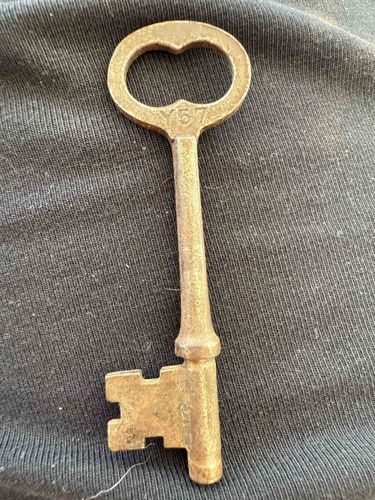
This is an antique barrel or warding key, likely crafted from iron or a similar ferrous alloy, exhibiting a rich, dark brown patina consistent with aged, oxidized metal. The key features a distinctive heart-shaped bow (handle) at its top, which is quite common for keys of the late 19th or early 20th century, but also has a more complex, almost figure-eight like internal cutout. Inscribed on the bow, beneath the central arch, are the numbers and letter 'Y57', indicating a possible serial number, batch number, or specific lock designation. The shank of the key is solid and tapers slightly towards the bit. There is a collar or a slight decorative ring where the shank meets the bit. The bit itself is a complex, multi-sided warding pattern, suggesting it was designed to operate a specific type of lock with internal obstructions, offering a degree of security beyond a simple skeleton key. The key's surface shows significant wear and pitting, indicative of prolonged use and exposure to environmental elements, but no major structural damage or repairs are immediately visible. The edges are softened from age and handling. This key's robust construction and complex bit design suggest it was intended for heavy-duty use, possibly for a large door, gate, chest, or a similar substantial locking mechanism. The craftsmanship appears to be a combination of forging and casting, common for this period, with evident tool marks and slight irregularities that speak to its age and manual production processes.
AI Appraisal Report
Upon visual examination of the provided image, I assess this antique barrel or warding key to be authentic for its reported period, likely late 19th to early 20th century. The rich, dark brown patina, significant wear, and pitting are consistent with aged, oxidized ferrous metal and prolonged use. The craftsmanship, combining forging and casting with visible tool marks, aligns with production methods of that era. The robust construction and complex multi-sided warding pattern suggest it was intended for a substantial lock, possibly for a large door or chest. The 'Y57' inscription on the heart-shaped bow is interesting and could indicate a serial or batch number, though its specific meaning is not determinable without further context.
In terms of market conditions, keys of this type, while charming, are not particularly rare. Collectors often seek out unique designs, unusual materials, or significant provenance. This key's design is attractive with its heart-shaped bow and complex bit, but it doesn't appear to stand out as exceptionally unique or historically significant without additional information. Comparables for similar antique iron keys with decorative bows and complex bits typically range from $20 to $100, depending on condition, size, and specific aesthetic appeal. Factors impacting value positively include its good overall condition despite wear, and the intricate bit design. The lack of specific provenance (e.g., from a known estate or associated with a historical building) limits its upper value potential.
It is crucial to note the limitations of authenticity verification from images alone. While the patina and wear suggest age, a physical examination would allow for tactile assessment of material, weight, and a closer inspection of manufacturing marks, which could reveal more precise dating or origin. I'd also be able to test for magnetivity to definitively confirm ferrous metal. Full authentication of the material composition and construction would benefit from microscopic analysis or even X-ray fluorescence (XRF) to determine the exact alloy. Without provenance documentation, its specific historical context and any associated value remain speculative.