AI estimate as of August 6, 2025 · verify with a professional before acting
AI-Generated · Verify before acting
Everything on this page is generated by AI for informational purposes only. AI can make mistakes — the AI may misidentify items or misattribute them (artist, maker, brand, designer, origin, era). This is not an official valuation and should not be used for insurance, sale, tax, estate, legal, or lending purposes — or any decision requiring a certified appraisal. It is not an authoritative claim about any person, brand, or rights holder — do not share or rely on it as a factual statement about a third party. Always consult qualified professionals before making financial decisions.
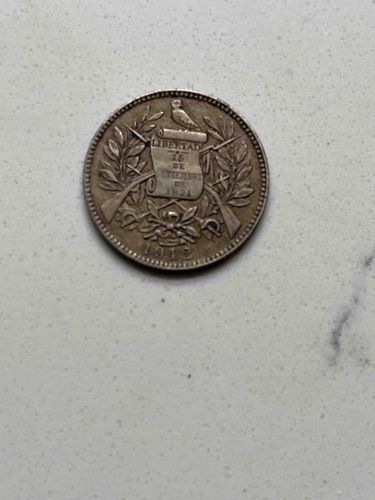
The item is a silver-toned coin, specifically the reverse side of a Guatemalan peso or similar denomination, likely struck from an alloy of silver, given its coloration and the period it represents. The central motif is the national coat of arms of Guatemala, featuring a scroll with the inscription "LIBERTAD / 15 DE / SEPTIEMBRE / DE 1821" (Liberty / September 15th / 1821), which commemorates the date of Central American independence from Spain. This scroll is flanked by two crossed rifles with bayonets, symbolizing the willingness to defend the nation's freedom. Above the scroll, a quetzal, the national bird of Guatemala, is perched, a symbol of liberty. Below the scroll and rifles, there are crossed swords, representing honor or military power, and a wreath of laurel branches, symbolizing victory and peace, tied at the bottom. The coin features a reeded edge, common for currency of this type and era, designed to prevent clipping. The visible date at the bottom is "1912". The surface exhibits a moderate level of wear consistent with circulation, with some loss of fine detail, particularly on the higher points of the design and the quetzal bird. There is a noticeable patina, typical of aged silver or silver alloy, which adds character but also slightly obscures some of the intricate details in the recessed areas. No significant damage such as deep scratches, bends, or repairs are immediately apparent from the image, suggesting it has been preserved reasonably well for its age. The overall craftsmanship appears to be of standard mint quality for early 20th-century coinage, with well-defined design elements, despite the wear. This coin is undoubtedly from the early 20th century, specifically dating to 1912.
AI Appraisal Report
I have examined the provided image of the reverse side of a Guatemalan coin, dated 1912. Based on the visual evidence, the coin appears to be authentic, displaying the expected design elements for the period, including the national coat of arms with its symbolic motifs (quetzal, scroll with independence date, rifles, swords, and laurel wreath). The reeded edge is also consistent with coinage of this era. The condition is good for its age, exhibiting moderate circulation wear across high points, notably the quetzal and some details within the coat of arms. A natural patina, typical of aged silver or silver alloy, is visible, which contributes to its character but slightly reduces the crispness of details in recessed areas. There are no major signs of damage like bends, repairs, or significant scratches.
Market conditions for early 20th-century Guatemalan coinage like this are generally stable. While not exceptionally rare, coins from this period, especially those with good eye appeal despite circulation, maintain collector interest. Comparable sales of similar Guatemalan 1912 reverse coins in circulated condition (Fine to Very Fine equivalent) typically range from moderately affordable for common dates to higher values for scarcer varieties or higher grades.
Demand is consistent among Latin American coin collectors and world coin enthusiasts. The primary factor impacting its value is its circulated condition, which places it below uncirculated or exceptionally fine examples. The natural patina is desirable and indicates originality.
It is crucial to note that this appraisal is based solely on visual examination of an image. Full authentication would require in-person examination to verify metallic composition, weight, and to inspect the edge for any signs of tampering not evident in the photograph. Microscopic analysis could confirm minting characteristics and detect alterations. Provenance documentation, if available, would also bolster authenticity. Without physical inspection, definitive authentication beyond a strong visual assessment is limited.