AI Appraisal Estimate

AI-generated estimates · not official valuations

From the user

What was submitted

Photo and notes provided by the user — not generated by AI

Submitted item photo
Submitted photo · June 27, 2026

User's notes

No additional notes provided.

AI analysis below

AI appraisal

AI analysis & estimate

AI-Generated · Verify before acting

Everything below is generated by AI for informational purposes only. AI can make mistakes — the AI may misidentify items or misattribute them (artist, maker, brand, designer, origin, era). This is not an official valuation and should not be used for insurance, sale, tax, estate, legal, or lending purposes — or any decision requiring a certified appraisal. It is not an authoritative claim about any person, brand, or rights holder — do not share or rely on it as a factual statement about a third party. Always consult qualified professionals before making financial decisions.

Read the full disclaimer

AI Identification

·Not independently authenticated·Verify before acting

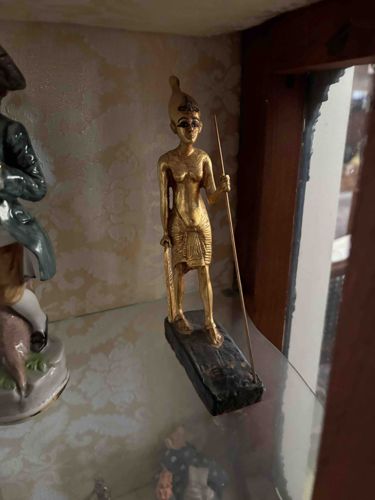
Gilded Composite Statuette of Pharaoh Tutankhamun on a Skiff

Collectible Statuettes / Egyptian Revival Decor

AI Estimated Value

·Not an official valuation·Verify before acting

$45-75

As of June 27, 2026

AI Item Analysis

·AI can make mistakes·Verify before acting
This is a decorative reproduction statuette of Pharaoh Tutankhamun, modeled after the original found in his tomb (KV62). The figure stands approximately 6 to 9 inches tall and is constructed from a composite material, likely resin or a heavy plaster, finished with a bright gold-toned metallic paint or leafing. The Pharaoh is depicted wearing the Red Crown of Lower Egypt (Deshret) with a prominent uraeus (cobra) on the brow. He is dressed in a pleated shendyt kilt with a long frontal flap, holding a long ritual harpoon or staff in his left hand and a coiled rope or flail in his right. The figure stands atop a dark, rectangular base textured to simulate the papyrus reed skiff seen in the original artifact. Notable features include the heavy kohl-rimmed eyes and traditional royal stance. The overall condition appears fair to good, though there are visible losses to the 'gold' finish on the high points of the fingers, crown, and kilt, revealing the darker base material beneath. The staff appears slightly bent, and there is dust accumulation in the recessed areas of the carving. Such items were typically produced as high-quality museum replicas or decorative souvenirs from the mid-to-late 20th century, particularly following the 'Tutmania' of the 1970s world tour.
AI Appraisal Report

·AI can make mistakes·Verify before acting
I have conducted a visual examination of this decorative statuette, a modern composite reproduction of the iconic Tutankhamun harpooning sculpture from KV62. Standing between 6 and 9 inches, the piece lacks the scale and material composition (gilded wood) of high-end museum resin casts or the original artifact. My assessment reveals a mid-century to late 20th-century mass-market souvenir, likely produced during the peak of 1970s 'Tutmania.' The condition is fair; significant finish loss on the crown, fingers, and kilt suggests a wear-prone metallic paint rather than gold leaf. The bent staff indicates a pliable, non-precious metal or plastic component. Market demand for these specific composite replicas remains steady among Egyptian Revival enthusiasts, but value is capped by the lack of a prominent museum foundry mark (such as the Alva Museum Replicas stamp). Comparables for unbranded resin Egyptian souvenirs consistently fall in the double-digit range. Limitations: This appraisal is based solely on digital images. A physical inspection is required to determine the exact substrate (resin vs. plaster) and to check for manufacturer marks on the underside of the 'skiff' base. Scientific testing (XRF) to determine the composition of the metallic finish would be required to rule out higher-grade gilding, though visual evidence of oxidation and flaking strongly suggests a decorative bronze-tone or gold-tone paint. Provenance documentation, such as an original purchase receipt from a 1970s exhibition tour, would provide a slight premium in provenance value but would not significantly alter the retail replacement value.

Get your items appraised

Instant estimates of your treasures with AI-powered appraisals

Browse More Appraisals