AI estimate as of July 25, 2025 · verify with a professional before acting
AI-Generated · Verify before acting
Everything on this page is generated by AI for informational purposes only. AI can make mistakes — the AI may misidentify items or misattribute them (artist, maker, brand, designer, origin, era). This is not an official valuation and should not be used for insurance, sale, tax, estate, legal, or lending purposes — or any decision requiring a certified appraisal. It is not an authoritative claim about any person, brand, or rights holder — do not share or rely on it as a factual statement about a third party. Always consult qualified professionals before making financial decisions.
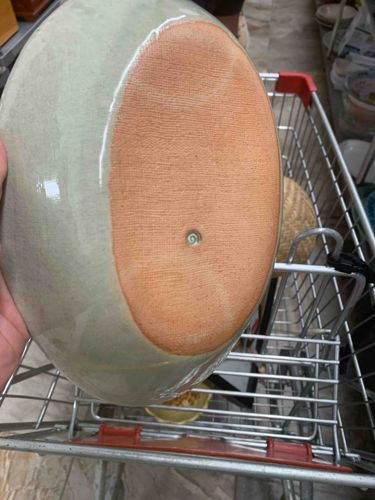
The item is a ceramic bowl, likely a serving bowl or deep dish bowl, characterized by its distinctive two-tone finish. The exterior, primarily visible from the side, is a pale, muted green or celadon color, exhibiting a smooth, glossy glaze that shows some minor crazing or crackling, which is a common and often desirable feature in certain ceramic glazes, indicating age or a specific firing technique. The base of the bowl, which is oval in shape, reveals the unglazed, reddish-brown terracotta or stoneware clay body. This unglazed portion has a visibly textured surface, possibly from an impression of fabric or a rough tool used during its creation, presenting a tactile contrast to the smooth glazed upper part. Near the center of the unglazed base, there is a small, notable spiral mark, possibly an impressed potter's mark or simply an decorative element, which provides a unique identifier. The transition between the glazed and unglazed sections is a clean, curved line, suggesting careful hand-dipping or a precise glazing technique. The overall construction appears robust and handcrafted, with the slightly irregular oval shape hinting at artisanal production rather than mass industrial manufacturing. There are no obvious chips, cracks, or significant damage visible, though the natural patina and variations in the glaze contribute to its character. The visible clay body suggests it could be a piece of modern studio pottery or have an East Asian aesthetic influence due to the celadon color and visible clay base, often found in traditional pottery from regions like China or Japan. The quality of craftsmanship appears good, with consistent glazing on the upper portion.
AI Appraisal Report
Upon visual examination of this two-tone glazed ceramic bowl, I find it to be a piece of studio pottery of good quality. The oval shape and hand-finished characteristics, such as the textured terracotta base and the small spiral mark, strongly suggest it is a unique, handcrafted item rather than a mass-produced one. The celadon-like glaze is well-applied, and the light crazing appears to be an intentional part of the aesthetic or a natural result of the firing process, not a sign of damage. The overall condition is excellent, with no visible chips or fractures.
The market for contemporary studio pottery is active, with values heavily dependent on the reputation of the potter. Without a clear maker's mark or signature, the piece is valued as a decorative object of quality craftsmanship. Its aesthetic, which blends modern and traditional East Asian influences, has broad appeal. Demand for such artisanal, functional art is steady among collectors and interior designers. The key factor limiting its value is its anonymity. If the spiral mark could be identified as belonging to a well-known ceramicist, its value could increase significantly.
It is important to note that this appraisal is based solely on images. Full authentication would require a physical examination to feel the texture, weight, and balance of the piece, and to more closely inspect a potential maker's mark under magnification. Comparison against a database of potters' marks would be necessary. Without this in-person verification or provenance, I cannot definitively attribute it to a specific artist or workshop, which is a critical step for a more precise valuation.