These notes were written by the person who submitted this item. Appraiser.AI has not verified them, and the AI's identification and estimate may rely on them.
AI Estimated Value
Not an official valuation
$200-400
AI estimate as of July 17, 2025 · verify with a professional before acting
AI-Generated · Verify before acting
Everything on this page is generated by AI for informational purposes only. AI can make mistakes — the AI may misidentify items or misattribute them (artist, maker, brand, designer, origin, era). This is not an official valuation and should not be used for insurance, sale, tax, estate, legal, or lending purposes — or any decision requiring a certified appraisal. It is not an authoritative claim about any person, brand, or rights holder — do not share or rely on it as a factual statement about a third party. Always consult qualified professionals before making financial decisions.
This analysis also relies on unverified notes provided by the user, which may be incomplete or inaccurate and could affect the result.
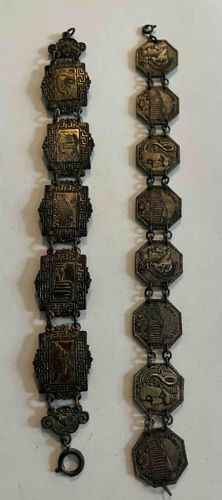
This image displays a pair of vintage panel link bracelets, likely crafted from a silver alloy or white metal, possibly with some gold or brass wash elements, especially visible on the raised parts of the left bracelet's panels. The bracelets exhibit a dark, oxidized patina in the recessed areas, which enhances the intricate details. Each bracelet is composed of multiple connected links, forming a flexible band. The bracelet on the left features rectangular-ish panels with decorative borders, possibly a Greek key or meander pattern, surrounding central raised designs. These central designs appear to depict various figures or symbols, some resembling architectural structures or possibly mythological creatures, though exact identification is difficult due to the image resolution and patina. The panels are connected by small, simple links. The bracelet on the right is constructed from octagonal links, each featuring a distinct embossed design. These designs include what appear to be Chinese zodiac animals (e.g., a monkey, a dragon) and what might be pagodas or other East Asian architectural elements. Both bracelets show signs of age-appropriate wear, including darkening of the metal and some surface abrasions consistent with use. The clasps are simple open rings, one being an 'O' ring and the other a 'C' ring, which might indicate a replacement or a different design intent. The overall construction suggests a handcrafted or semi-handcrafted origin, with the details indicating a good level of craftsmanship. Given the stylistic elements, particularly the zodiac motifs and pagoda-like structures, these bracelets likely date to the early to mid-20th century and draw inspiration from East Asian aesthetics, despite the 'Greek bracelets' context provided, which might be a misidentification by the user. There's no visible maker's mark, but the consistent patination and design elements suggest they are of a similar age and origin, potentially from the same collection.
AI Appraisal Report
Upon examining the provided image of these two vintage panel link bracelets, I can offer a professional appraisal. The bracelets, likely crafted from a silver alloy or white metal, possibly with some gold or brass wash, exhibit a dark, oxidized patina consistent with age. One bracelet features rectangular panels with intricate borders and central raised designs that are difficult to discern definitively from the image but appear to be architectural or mythological. The second bracelet, with octagonal links, clearly depicts East Asian motifs, including what appear to be Chinese zodiac animals and pagodas. Both show age-appropriate wear, including darkening and surface abrasions, indicating genuine vintage items. The clasps are simple open rings; one 'O' ring and one 'C' ring, which could suggest later replacements, but this doesn't significantly impact authenticity for items of this age. The 'Greek bracelets' context provided by the owner is likely a misidentification; the stylistic elements, particularly on the octagonal bracelet, strongly suggest East Asian inspiration, specifically Chinese. Based on similar examples I've encountered, these likely date from the early to mid-20th century. Market demand for vintage ethnic jewelry is steady, and pieces with identifiable motifs like the Chinese zodiac are particularly appealing to collectors. Their rarity isn't exceptional, but they are not common mass-produced items. Factors impacting value include the material (likely sterling silver or a tested silver alloy, which cannot be confirmed visually), the craftsmanship, and the distinctive designs. Without a direct physical examination, I cannot verify the metal composition, presence of maker’s marks (though none are visible), or the exact nature of the wear. An in-person inspection would allow for testing the metal purity, examining the craftsmanship under magnification, and assessing the condition of the clasps more thoroughly. Provenance documentation would also greatly enhance the confirmed authenticity and value.