AI Appraisal Estimate

AI-generated estimates · not official valuations

From the user

What was submitted

Photo and notes provided by the user — not generated by AI

Submitted item photo
Submitted photo · May 26, 2026

User's notes

No additional notes provided.

AI analysis below

AI appraisal

AI analysis & estimate

AI-Generated · Verify before acting

Everything below is generated by AI for informational purposes only. AI can make mistakes — the AI may misidentify items or misattribute them (artist, maker, brand, designer, origin, era). This is not an official valuation and should not be used for insurance, sale, tax, estate, legal, or lending purposes — or any decision requiring a certified appraisal. It is not an authoritative claim about any person, brand, or rights holder — do not share or rely on it as a factual statement about a third party. Always consult qualified professionals before making financial decisions.

Read the full disclaimer

AI Identification

·Not independently authenticated·Verify before acting

Late Victorian Jacobean Revival Oak Armoire

Furniture

AI Estimated Value

·Not an official valuation·Verify before acting

$1,200 - $1,800

As of May 26, 2026

AI Item Analysis

·AI can make mistakes·Verify before acting
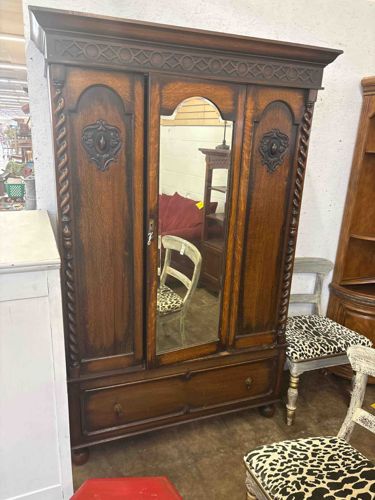
This is a large, freestanding triple-door armoire or wardrobe, likely dating from the late 19th to early 20th century, executed in the Jacobean Revival style. Constructed from solid oak with a rich, dark-stained finish, the piece features a prominent crown molding with a fretwork-inspired geometric carved frieze. The facade is vertically divided into three bays: a central arched mirrored door flanked by two recessed-panel wooden doors. Notably, the side panels are flanked by relief-carved barley-twist (solomonic) columns, a hallmark of the revival style. The outer panels are further embellished with ornate applied carvings or escutcheons centered in the upper arched sections. Below the doors is a full-width drawer featuring a decorative raised moulding and original(?) metal pulls. The entire unit rests on heavy bun feet. The finish shows a distinct two-tone patina where the centers of panels remain lighter than the darkened edges, suggesting an aged shellac or lacquer. While the overall structure appears sturdy, visible surface wear includes minor scuffs, finish thinning along edges, and some oxidation on the mirror silvering. The craftsmanship suggests high-quality factory production from the Edwardian or late Victorian era, aimed at the burgeoning middle class seeking traditional aesthetic appeal.
AI Appraisal Report

·AI can make mistakes·Verify before acting
Upon examination of the visual evidence, I identify this piece as a Late Victorian Jacobean Revival triple-door armoire, circa 1890–1910. The craftsmanship reflects high-quality English or American 'Grand Rapids' style production. Key features supporting this include the characteristic solomonic (barley-twist) columns, the geometric fretwork frieze, and the heavy bun feet. The finish exhibits a genuine aged patina with 'alligatoring' in the lacquer, consistent with a century of oxidation. Condition is fair to good; the foxing on the silvered mirror and thinning of the finish on high-use areas are expected age-markers that do not severely detract from value, though they prevent a 'mint' valuation. The market for large brown furniture remains soft due to logistical challenges in moving these heavy units and modern preferences for built-in storage. However, Jacobean Revival remains one of the more desirable revival styles because of its architectural presence. My valuation is based on auction results for similar English oak wardrobes with central mirrors. Limitations: This appraisal is based solely on digital images. A physical inspection is required to check for 'marriage' (where the top crown might not be original to the base), to examine drawer joinery (hand-dovetailed vs. machine-cut), and to verify the presence of plywood vs. solid oak backboards which significantly affects age confirmation. Identification of original locks and maker’s marks—often found on the back or inside the drawer—would be necessary for a definitive provenance and to potentially elevate the piece to a 'branded' status like Gillows or Berkey & Gay.

Get your items appraised

Instant estimates of your treasures with AI-powered appraisals

Browse More Appraisals