AI estimate as of July 26, 2025 · verify with a professional before acting
AI-Generated · Verify before acting
Everything on this page is generated by AI for informational purposes only. AI can make mistakes — the AI may misidentify items or misattribute them (artist, maker, brand, designer, origin, era). This is not an official valuation and should not be used for insurance, sale, tax, estate, legal, or lending purposes — or any decision requiring a certified appraisal. It is not an authoritative claim about any person, brand, or rights holder — do not share or rely on it as a factual statement about a third party. Always consult qualified professionals before making financial decisions.
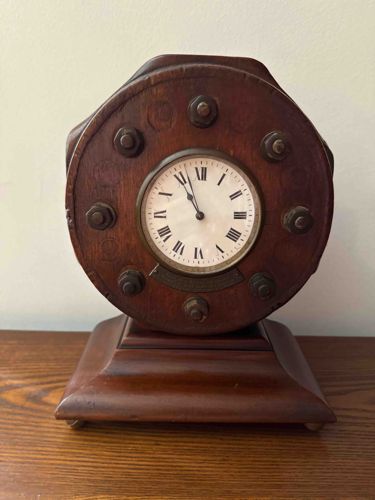
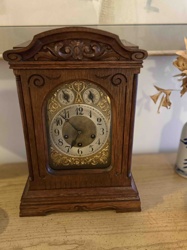
This exquisite piece is an antique or vintage ship's clock, presented in a robust wooden case designed to mimic the aesthetic of a ship's porthole or a deeply encased instrument. The primary material appears to be a rich, dark-stained hardwood, possibly mahogany or oak, displaying a warm reddish-brown hue. The circular face of the clock is set into a thick, cylindrical or barrel-shaped body, which is secured to a rectangular, stepped plinth base.
The most striking physical characteristic of the main clock body is the presence of numerous protruding, dark-colored 'bolts' or 'rivets' that encircle the clock face, simulating the fastening mechanisms of a porthole. There are at least eight such elements visible around the perimeter of the circular wooden case. The clock face itself is white with bold black Roman numerals and distinct minute markers, enclosed within a brass or bronze bezel which shows some signs of patina or tarnishing, indicative of age. The hands are slender and black, complementing the numerals. Below the clock face, there appears to be a small rectangular brass plaque or escutcheon, too worn or dark to discern any specific inscriptions.
The overall construction suggests durability, with the thick wood and visible 'fasteners' contributing to a rugged, maritime aesthetic. The wood exhibits a discernible grain and a smooth, worn finish consistent with age and handling. There are some minor surface abrasions and superficial marks visible on the wooden casing and base, consistent with normal wear and tear over time, but no significant damage like cracks or chips is apparent. The craftsmanship appears to be of good quality, with precise joinery visible where the main body meets the base. The style period likely falls within the late 19th to early 20th century, given its design cues, material choices, and the common use of such 'porthole' style clocks during that era. Its substantial build also hints at its potential original purpose as a functional instrument in a nautical setting.
AI Appraisal Report
Upon my virtual examination of this Antique Porthole-Style Ship's Desk Clock, I am impressed by its robust construction and aesthetic appeal. The dark-stained hardwood, likely mahogany or oak, appears well-preserved, exhibiting a warm patina consistent with age. The 'porthole' design with visible 'bolts' is a charming and historically accurate touch for a nautical timepiece. I noted the clear white face with bold Roman numerals, suggesting good legibility. The brass or bronze bezel shows appropriate signs of age-related tarnishing, which adds to its authenticity.
In terms of condition, the wood presents with minor surface abrasions consistent with normal wear but appears free of significant damage like cracks or chips. This indicates it has been well-cared for. The craftsmanship appears solid, with good joinery evident.
Regarding market conditions, genuine antique nautical instruments, particularly well-preserved clocks, maintain a steady demand among collectors of maritime memorabilia and decorative arts. Comparable sales of similar 'porthole' or ship clocks from the late 19th to early 20th century, especially those with original movements (which I cannot verify visually), typically range from $300 to $700. Factors impacting value include the wood species (mahogany often fetches more), the originality and condition of the clock movement, and whether it's still in working order. Rarity is moderate; while many ship clocks exist, well-preserved desk models in this style are less common than wall-mounted versions.
My primary limitation in this appraisal is the absence of a physical examination. I cannot ascertain the originality or functionality of the internal clock movement, which is critical for valuation. A visual inspection does not confirm if the 'bolts' are decorative or structural, nor can I read any potential maker's marks or serial numbers on the brass plaque or movement itself. To fully authenticate and confirm the age, origin, and functional condition, an in-person examination by a horologist, assessment of provenance documentation, and potential scientific testing of the wood or metal components would be necessary.