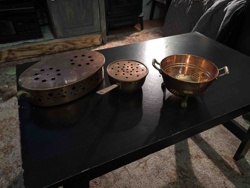
Old Simplex tea pot Copper tea pot. Late 1800s or earlier 20th century
These notes were written by the person who submitted this item. Appraiser.AI has not verified them, and the AI's identification and estimate may rely on them.
AI Estimated Value
Not an official valuation
$60 - $120
AI estimate as of October 6, 2025 · verify with a professional before acting
AI-Generated · Verify before acting
Everything on this page is generated by AI for informational purposes only. AI can make mistakes — the AI may misidentify items or misattribute them (artist, maker, brand, designer, origin, era). This is not an official valuation and should not be used for insurance, sale, tax, estate, legal, or lending purposes — or any decision requiring a certified appraisal. It is not an authoritative claim about any person, brand, or rights holder — do not share or rely on it as a factual statement about a third party. Always consult qualified professionals before making financial decisions.
This analysis also relies on unverified notes provided by the user, which may be incomplete or inaccurate and could affect the result.
This is a vintage Simplex tea kettle, constructed primarily of copper with brass accents and a dark-stained or ebonized wooden handle. The kettle features a robust, rounded body with a distinct lower band that suggests a double-bottom or reinforced base, a common characteristic for Simplex kettles designed for efficient boiling. The copper has developed a rich, variegated patina, indicative of its age and use, with areas of darker oxidation and some lighter, possibly cleaned or worn, spots. There are minor surface irregularities and small pitting visible, consistent with aged copperware. The 'swan-neck' style gooseneck spout is also copper, attached to the main body. The handle, which is arched over the top of the kettle, is made of brass, showing some tarnishing and green verdigris, particularly where it meets the copper body. The handle itself is segmented, with a darker central portion, likely wood, providing a comfortable grip. The lid is domed copper with a dark, possibly wooden or bakelite, knob. The overall craftsmanship appears solid, with visible seams suggesting a hand-assembled or early machine-made construction. The style points to a late 19th or early 20th-century piece, aligning with the period when copper kettles, especially Simplex models, were popular for their heating efficiency and aesthetic appeal. No specific maker's marks are discernible from the provided image, but the overall design strongly matches known Simplex kettles.
AI Appraisal Report
Upon visual examination of the provided images, this item presents as a vintage copper tea kettle, attributed to the Simplex brand, likely dating from the late 19th to the early 20th century. The construction, featuring a robust copper body, gooseneck spout, and an ebonized wood handle set in brass hardware, aligns with the known design characteristics of Simplex kettles from this era. The condition appears fair for its age, displaying a developed patina, minor surface pitting, and some verdigris on the brass elements. These signs of age and use are expected and can be desirable to certain collectors, but significant dents or unrepaired leaks, which cannot be assessed from photos, would negatively impact value.
Market analysis of comparable vintage Simplex copper kettles shows a wide range of sold prices, heavily influenced by specific model, age, and condition. While highly polished or rare models can achieve higher values, examples similar to this one, with visible wear and patina, typically trade in the $60 to $120 range. The demand for vintage copper kitchenware remains steady, particularly for decorative purposes. The primary factor limiting the value is its condition and the high production numbers of Simplex kettles, which makes them relatively common.
It is crucial to note the limitations of an appraisal based on images alone. A definitive authentication and valuation would require an in-person examination to search for a maker's mark (often stamped on the base), assess the interior for descaling or damage, and confirm the integrity of all seams and joints. Without physical inspection, the attribution to Simplex and the late 19th/early 20th-century dating remain probable but unconfirmed.