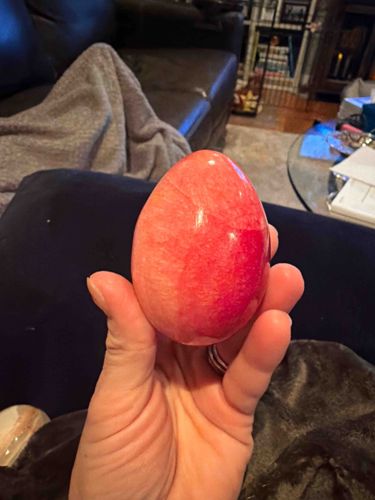
Polished Pink Alabaster or Marble Decorative Egg
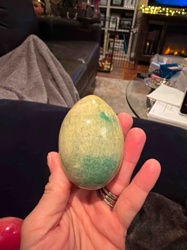
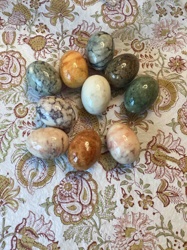
This item is a hand-held decorative object carved in the shape of an egg, measuring approximately 2.5 to 3 inches in height. It is crafted from a natural mineral stone, likely alabaster or marble, which has been dyed a vibrant pink or coral hue. The piece exhibits a high-gloss, polished finish that reflects light smoothly across its surface. The coloration is not uniform, showing natural internal variations, veining, and feathered patterns ranging from pale salmon to deep magenta, which are characteristic of dyed translucent soft stones. There are visible crystalline structures beneath the surface, suggesting a metamorphic or sedimentary origin. In terms of condition, the egg appears well-preserved with no significant chips or cracks visible, though a few minor surface scuffs may be present upon close tactical inspection. It lacks any visible maker's marks or signatures, which is common for mid-20th-century lapidary giftware often produced in Italy or Pakistan. The craftsmanship is of good commercial quality, with a symmetrical form and a consistent, professional polish. This style of stone egg became a popular collectible and home decor accent during the 1960s and 1970s, frequently used as paperweights or displayed in bowls.
AI-Generated Appraisal Disclaimer
Estimated Value
$15.00 - $25.00
Basic Information
Category
Collectibles / Lapidary Decor
Appraised On
March 16, 2026
Estimated Value
$15.00 - $25.00
Item Description
This item is a hand-held decorative object carved in the shape of an egg, measuring approximately 2.5 to 3 inches in height. It is crafted from a natural mineral stone, likely alabaster or marble, which has been dyed a vibrant pink or coral hue. The piece exhibits a high-gloss, polished finish that reflects light smoothly across its surface. The coloration is not uniform, showing natural internal variations, veining, and feathered patterns ranging from pale salmon to deep magenta, which are characteristic of dyed translucent soft stones. There are visible crystalline structures beneath the surface, suggesting a metamorphic or sedimentary origin. In terms of condition, the egg appears well-preserved with no significant chips or cracks visible, though a few minor surface scuffs may be present upon close tactical inspection. It lacks any visible maker's marks or signatures, which is common for mid-20th-century lapidary giftware often produced in Italy or Pakistan. The craftsmanship is of good commercial quality, with a symmetrical form and a consistent, professional polish. This style of stone egg became a popular collectible and home decor accent during the 1960s and 1970s, frequently used as paperweights or displayed in bowls.
Get Your Items Appraised
Instant estimates of your treasures with AI-powered instant appraisals