AI estimate as of July 11, 2025 · verify with a professional before acting
AI-Generated · Verify before acting
Everything on this page is generated by AI for informational purposes only. AI can make mistakes — the AI may misidentify items or misattribute them (artist, maker, brand, designer, origin, era). This is not an official valuation and should not be used for insurance, sale, tax, estate, legal, or lending purposes — or any decision requiring a certified appraisal. It is not an authoritative claim about any person, brand, or rights holder — do not share or rely on it as a factual statement about a third party. Always consult qualified professionals before making financial decisions.
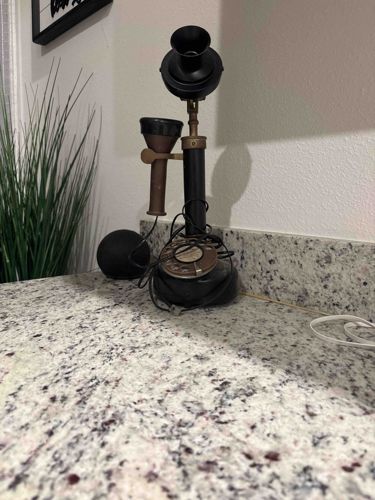
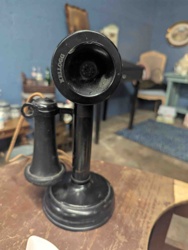
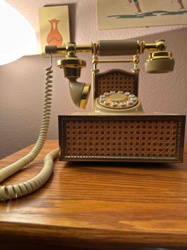
The item depicted is a vintage or reproduction candlestick telephone, characteristic of late 19th to early 20th-century designs. It is primarily constructed from dark-colored materials, likely metal (possibly brass or cast iron) and bakelite or similar hard plastic components, with some brass-toned accents visible on the central column and the 'neck' of the transmitter. The phone features a tall, slender central column, predominantly black, which houses the speaking trumpet (transmitter) at its top. This transmitter is a distinct, funnel-shaped black piece, flaring upwards. Below and to the side of the central column is the receiver, held in a cradle. The receiver itself appears to be a separate, elongated cylindrical piece with a flared ear-piece, connecting to the main body via a dark cord. The base of the telephone is wider and rounded, also in a dark color, and it seems to have some internal mechanism or weighted design. Visible condition issues include some general wear consistent with age or replication, such as minor scuffs on the dark finishes and possible patina on the brass-toned elements. The cords associated with the receiver are visible and appear somewhat tangled, suggesting a lack of tidy storage but not necessarily significant damage. There are no clearly visible maker's marks or signatures from the provided image, making it difficult to determine the exact manufacturer or historical provenance without closer inspection. The overall aesthetic points to a sturdy, functional design from an era when telephones were becoming common household items, emphasizing both utility and a certain level of craftsmanship in their appearance.
AI Appraisal Report
Upon visual examination of the provided image, I assess this candlestick telephone to be in good, used condition. The dark finishes show general wear consistent with age, including minor scuffs, and the brass-toned elements display some patina. The receiver cord appears somewhat tangled, but there's no overt damage. While it possesses the characteristic design of late 19th to early 20th-century models, authenticity as an original antique versus a reproduction is difficult to definitively determine from images alone. The construction materials—metal, bakelite, and brass-toned accents—are consistent with period pieces, but also commonly used in reproductions.
Market conditions for vintage telecommunications devices, particularly candlestick telephones, are relatively stable. Demand exists among collectors of antique electronics, prop houses, and those seeking decorative historical pieces. Rarity is highly dependent on originality, manufacturer, and specific model; original, well-preserved examples from known manufacturers like Western Electric or Stromberg-Carlson are scarcer and command higher prices than generic versions or reproductions.
Factors significantly impacting value include confirmed authenticity, the manufacturer's identity, and the extent of restoration. Without visible maker's marks or provenance, its value leans more towards a decorative or generic vintage piece rather than a highly collectible antique. Therefore, I estimate a moderate value based on its visual appeal and presumed function.
For full authentication, in-person examination is crucial. This would allow for close inspection of internal components, material composition (e.g., specific metal alloys, plastics), and the presence of hidden maker's marks or patent numbers. Provenance documentation, such as original sales receipts or historical ownership records, would be invaluable. Scientific testing, like material analysis, could confirm time-period appropriate materials.