AI estimate as of October 30, 2025 · verify with a professional before acting
AI-Generated · Verify before acting
Everything on this page is generated by AI for informational purposes only. AI can make mistakes — the AI may misidentify items or misattribute them (artist, maker, brand, designer, origin, era). This is not an official valuation and should not be used for insurance, sale, tax, estate, legal, or lending purposes — or any decision requiring a certified appraisal. It is not an authoritative claim about any person, brand, or rights holder — do not share or rely on it as a factual statement about a third party. Always consult qualified professionals before making financial decisions.
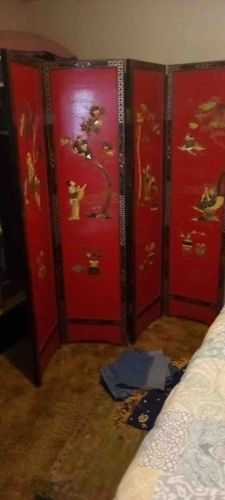
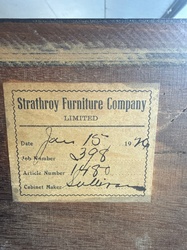
This is a multi-panel, foldable room screen, likely originating from an East Asian country such as China, Japan, or Korea. The screen consists of at least four panels, although based on its extended form, there could be more not fully visible. Each panel is rectangular with a subtly curved or notched top, and a slight outward curve at the bottom, suggesting a traditional design. The dominant color is a striking bright red lacquer, which serves as a vibrant background for decorative elements. The lacquer appears to have a somewhat glossy finish, but given the image quality, minor surface wear, scuffs, or inconsistencies cannot be ruled out, though no major damage is immediately apparent. The panels are framed by dark, possibly black or very dark brown, borders that feature intricate, geometric patterns, possibly applied relief work or inlay, which adds a sophisticated textural contrast to the smooth red panels. The primary decoration on the red panels consists of depictions of figures, foliage (including tree branches and individual leaves), and possibly architectural or landscape elements, all rendered in what appears to be mother-of-pearl inlay, possibly combined with gold leaf or painted accents. The figures are dressed in traditional garb and appear to be engaged in various activities, contributing to a narrative or genre scene. The overall style suggests an antique or vintage piece, likely from the early to mid-20th century. The craftsmanship, particularly the detailed inlay and painted elements, points to a moderate to high level of quality, characteristic of decorative screens intended for a formal or semi-formal interior setting. No visible manufacturer's marks or signatures are discernable from the provided image.
AI Appraisal Report
Based on my visual examination of the provided image, this East Asian Lacquered Room Screen with Mother-of-Pearl Inlay presents as a decorative and relatively well-preserved piece. The vibrant red lacquer and intricate mother-of-pearl inlay suggest a good level of craftsmanship, likely from a Chinese or Korean origin given the style of the figures and motifs. The subtle curvature of the panels and the geometric patterns on the dark borders further indicate a traditional aesthetic. I assess its condition as good to very good; while I cannot rule out minor surface wear, scuffs, or inconsistencies in the lacquer without a direct inspection, no major damage or losses are immediately evident from the image. The inlay appears intact, which is a significant factor.
Authenticity, based solely on imagery, is challenging. The overall style is consistent with early to mid-20th century East Asian decorative screens. For full authentication, an in-person examination would be crucial to assess the quality of the lacquer application, the true material of the inlay (e.g., actual mother-of-pearl vs. a synthetic substitute), and construction techniques. Provenance documentation, such as receipts or historical records, would further solidify its authenticity and origin. Scientific testing could verify material composition if doubt arose.
In terms of market conditions, decorative screens of this style and quality generally see moderate demand within the broader antiques and vintage furniture market. Values are largely driven by condition, the intricacy and quality of the decorative elements, and origin. Comparables in similar condition and decorative complexity typically range from $1,000 to $3,000, with exceptional pieces commanding more. The apparent good condition and detailed inlay are positive factors impacting its value. Rarity is not exceptionally high for such screens, as many were produced, but well-preserved examples with appealing aesthetics like this one tend to hold their value better. Given these considerations, I would place the appraisal value between $1,500 and $2,500.