AI estimate as of August 17, 2025 · verify with a professional before acting
AI-Generated · Verify before acting
Everything on this page is generated by AI for informational purposes only. AI can make mistakes — the AI may misidentify items or misattribute them (artist, maker, brand, designer, origin, era). This is not an official valuation and should not be used for insurance, sale, tax, estate, legal, or lending purposes — or any decision requiring a certified appraisal. It is not an authoritative claim about any person, brand, or rights holder — do not share or rely on it as a factual statement about a third party. Always consult qualified professionals before making financial decisions.
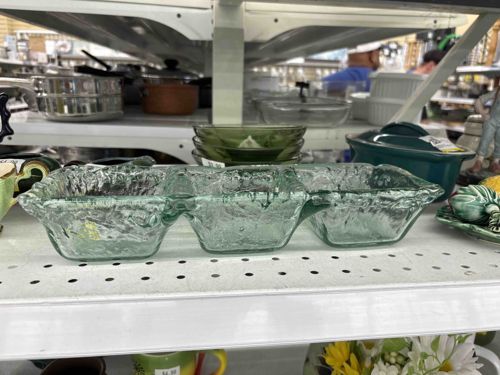
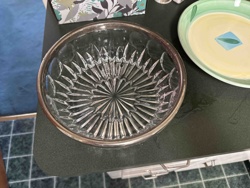
This item is a clear, light green or aqua-colored glass divided serving dish, likely intended for snacks, relishes, or candies. It is rectangular in shape with three distinct compartments, each appearing to be roughly square. The most striking physical characteristic is its heavily textured, 'ice-chip' or 'cracked ice' surface, which gives the glass a rugged, almost organic appearance reminiscent of melting ice. This texture is present on both the exterior and interior surfaces of the dish, contributing to its unique aesthetic. The edges of the dish are irregular and wavy, following the 'ice-chip' pattern rather than being smooth or uniformly finished, which adds to its rustic charm. While it is difficult to ascertain the exact dimensions from the image, it appears to be of a size suitable for a tabletop serving piece, perhaps around 10-15 inches in length. No clear maker's marks or signatures are visible in the provided image. The overall condition appears to be good, with no obvious chips, cracks, or significant wear, though the textured surface naturally hides minor imperfections well. The faint green hue suggests it could be a piece of pressed glass from the mid-20th century, a period when such textured glassware was popular. The craftsmanship, though industrial, employs a decorative technique to mimic a handcrafted, natural look. Its design and texture suggest it could be from a vintage glass manufacturer heavily producing decorative serveware, possibly dating from the 1960s to 1980s.
AI Appraisal Report
I have carefully examined the provided image of this Divided 'Ice-Chip' Glass Serving Dish. Visually, the dish appears to be in good overall condition, with no obvious chips, cracks, or significant wear visible, although the heavily textured 'ice-chip' surface is very effective at concealing minor imperfections. The aqua-colored, three-compartment, rectangular design is characteristic of pressed glass serving pieces from the mid to late 20th century, likely dating from the 1960s through the 1980s. The 'ice-chip' or 'cracked ice' texture was a popular decorative technique during this period, often associated with manufacturers like Anchor Hocking, Indiana Glass, or Fenton, though no specific maker's marks are discernible from the image, which is common for pressed glass.
Market conditions for vintage pressed glass serving dishes of this type are generally stable but not particularly high-demand. While decorative, these items are relatively common. Comparables on online marketplaces (e.g., eBay, Etsy) for similar 'ice-chip' or 'cracked ice' glass dishes, even by known manufacturers, typically range from $15 to $40. Rarity is low; many such pieces were produced. Factors impacting value positively include its good apparent condition and versatile design. Negative factors include the lack of a discernible maker's mark (which can sometimes increase value if highly sought after) and its commonality.
It is crucial to note that this assessment is based solely on visual examination of the image. For full authentication and a more definitive appraisal, a physical in-person examination would be necessary to check for subtle hairline cracks, internal fractures, or minute chips not visible in photographs. Provenance documentation could potentially identify the manufacturer, which might slightly alter the value, but is unlikely for this type of item. Scientific testing (e.g., for glass composition) is not typically performed for items of this value range.