Carved Antique Indo-Portuguese or Anglo-Indian Teak Buffet Sideboard
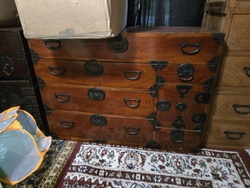
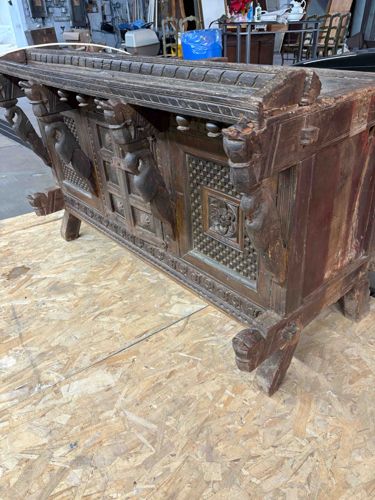
This substantial piece of antique furniture is a hand-carved buffet or sideboard, likely originating from the Indian subcontinent, potentially 19th-century Indo-Portuguese or Anglo-Indian in style. Constructed from a dense, dark-toned wood—most likely weathered teak—it features an array of intricate relief carvings. The facade is divided into several panels: some display characteristic floral medallions centered within a studded or geometric grid pattern, while others feature classical framing. A defining aesthetic feature is the series of large, zoomorphic or stylized avian brackets (likely Hamsa or Gajasimha motifs) that support the overhanging top edge and the lower base. The top rail is decorated with a repeating gadrooned or fluted motif. In terms of condition, the piece shows significant signs of age and wear appropriate for an antique. There is visible surface weathering, minor wood splitting (checks) due to age, and small losses to the sharp edges of the carvings. The dark patina is uneven, suggesting exposure to varying levels of humidity or light over time. No visible maker's marks are apparent, which is common for regional colonial-period craftsmanship. The heavy-set legs are carved ending in blocky, scrolled feet, providing a grounded, architectural presence. Use of joinery appears traditional, with visible pegs and mortise-and-tenon construction.
AI-Generated Appraisal Disclaimer
Estimated Value
$4,500 - $6,500
Basic Information
Category
Antique Furniture
Appraised On
January 9, 2026
Estimated Value
$4,500 - $6,500
Item Description
This substantial piece of antique furniture is a hand-carved buffet or sideboard, likely originating from the Indian subcontinent, potentially 19th-century Indo-Portuguese or Anglo-Indian in style. Constructed from a dense, dark-toned wood—most likely weathered teak—it features an array of intricate relief carvings. The facade is divided into several panels: some display characteristic floral medallions centered within a studded or geometric grid pattern, while others feature classical framing. A defining aesthetic feature is the series of large, zoomorphic or stylized avian brackets (likely Hamsa or Gajasimha motifs) that support the overhanging top edge and the lower base. The top rail is decorated with a repeating gadrooned or fluted motif. In terms of condition, the piece shows significant signs of age and wear appropriate for an antique. There is visible surface weathering, minor wood splitting (checks) due to age, and small losses to the sharp edges of the carvings. The dark patina is uneven, suggesting exposure to varying levels of humidity or light over time. No visible maker's marks are apparent, which is common for regional colonial-period craftsmanship. The heavy-set legs are carved ending in blocky, scrolled feet, providing a grounded, architectural presence. Use of joinery appears traditional, with visible pegs and mortise-and-tenon construction.
Related Tags
Explore similar items and categories:
Get Your Items Appraised
Instant estimates of your treasures with AI-powered instant appraisals