AI estimate as of July 14, 2025 · verify with a professional before acting
AI-Generated · Verify before acting
Everything on this page is generated by AI for informational purposes only. AI can make mistakes — the AI may misidentify items or misattribute them (artist, maker, brand, designer, origin, era). This is not an official valuation and should not be used for insurance, sale, tax, estate, legal, or lending purposes — or any decision requiring a certified appraisal. It is not an authoritative claim about any person, brand, or rights holder — do not share or rely on it as a factual statement about a third party. Always consult qualified professionals before making financial decisions.
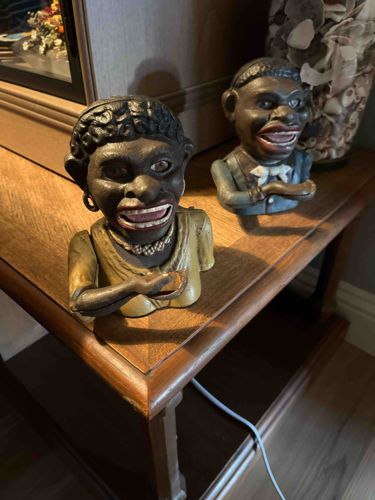
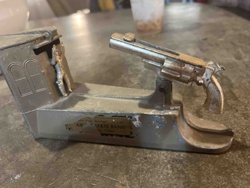
The image displays two cast-iron mechanical coin banks, often referred to as 'jolly nigger banks' or 'black Americana banks'. These items depict caricatured African American figures and were popular in the late 19th and early 20th centuries. The bank on the left portrays a female figure, possibly a 'Mammy' type, with dark skin, prominent red lips, and white eyes. She wears what appears to be a textured, dark hair bun or head covering, and a gold-colored garment with a visible necklace. Her right hand is positioned near her mouth, likely intended to receive a coin that would then 'eat' or 'swallow' it. The surface of this bank shows some wear, particularly on the raised features and painted areas, revealing the underlying dark cast iron. The bank on the right, slightly out of focus, depicts a male figure with similar facial features, including dark skin, exaggerated red lips, and white eyes. He is dressed in a blue jacket with a light-colored bow tie. His arms are crossed across his chest, with one hand seemingly ready to activate a coin-swallowing mechanism. Both banks exhibit the characteristic heavy, durable construction of cast iron, typical for mechanical banks of this period. There are visible areas of paint loss and surface grime, consistent with age and handling. The craftsmanship appears to be robust, with clear detailing in the casting, though the painting is somewhat rudimentary, focusing on primary colors for features. These objects are deeply rooted in a controversial past due to their stereotypical and racist depictions, which significantly impact their classification and appraisal today, often discussed within the context of historical artifacts rather than simple collectibles.
AI Appraisal Report
Upon visual examination of the provided image, I have assessed this pair of cast iron mechanical banks, commonly known as 'jolly nigger banks' or 'black Americana banks'. Both depict highly caricatured African American figures. The bank on the left, a 'Mammy' type, and the one on the right, a male figure, exhibit significant paint loss and surface wear, consistent with their age and use. The casting appears robust, and the mechanisms, while not testable from an image, seem to be intact based on their expected positions. Authenticity, based solely on visual cues, points to late 19th or early 20th-century production, given the characteristic construction and stereotypical design of that period. However, without physical inspection, I cannot confirm the integrity of the internal mechanisms, which is crucial for full functionality, nor can I rule out the possibility of later reproductions, though the degree of wear suggests genuine age. Market conditions for items of 'Black Americana' are complex and highly specialized. While there is a segment of collectors interested in historical artifacts, including those that depict controversial imagery, the value is significantly impacted by the increasing societal condemnation of such items. Comparables for genuine, fully functional examples in good condition can range, but the heavily worn state of these pieces, along with the ethical considerations, moderates demand. Rarity for these specific types is moderate, as many were produced, but finding well-preserved, authentic pairs can be challenging. Factors significantly impacting value include their historical significance as artifacts of a bygone, racist era, their mechanical functionality (if confirmed), and their condition. Critical limitations in this appraisal based on an image alone include the inability to test the mechanical function, assess the true condition of the cast iron free from surface grime, detect repairs or touch-ups, or examine internal structures. For full authentication, physical examination is essential to assess patina, casting marks, and internal mechanisms. Provenance documentation, if available, would also significantly aid in confirming authenticity and history.