These notes were written by the person who submitted this item. Appraiser.AI has not verified them, and the AI's identification and estimate may rely on them.
AI Estimated Value
Not an official valuation
$3,000 - $5,000
AI estimate as of September 23, 2025 · verify with a professional before acting
AI-Generated · Verify before acting
Everything on this page is generated by AI for informational purposes only. AI can make mistakes — the AI may misidentify items or misattribute them (artist, maker, brand, designer, origin, era). This is not an official valuation and should not be used for insurance, sale, tax, estate, legal, or lending purposes — or any decision requiring a certified appraisal. It is not an authoritative claim about any person, brand, or rights holder — do not share or rely on it as a factual statement about a third party. Always consult qualified professionals before making financial decisions.
This analysis also relies on unverified notes provided by the user, which may be incomplete or inaccurate and could affect the result.
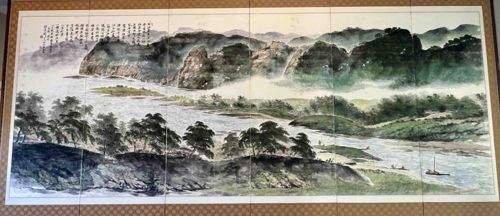
This item is a multi-panel painting depicting a serene East Asian landscape, likely part of a byōbu (folding screen) or fusuma (sliding door) due to its segmented nature and overall composition. The artwork showcases a vast river or lake winding through mountainous terrain, with numerous trees dotting the foreground and midground. The color palette is dominated by muted greens, grays, and whites, suggestive of ink wash painting with subtle color accents. Hazy white areas throughout the mountainous regions create a sense of mist or fog, characteristic of traditional East Asian landscape art, often referred to as 'shan shui' (mountain-water painting). In the upper left panel, there is a significant section of black calligraphy, indicating that this is a hand-painted piece and possibly includes a poem, dedication, or artist's signature. Small figures appear to be present in boats on the water and possibly along the shore, adding a sense of scale and human presence within the grand natural setting. The painting appears to be executed on a light-colored paper or silk substrate, which is then mounted onto a panel structure. The visible borders around the painting suggest a mounting process, and the overall checkered pattern of the larger frame implies it is either a segment of a screen or framed in a traditional manner. The condition seems generally good, though some slight discoloration or age-related toning of the paper/silk might be present given its likely age. The brushwork exhibits a fluid and expressive quality, particularly in the rendering of the trees and distant mountains, indicating skilled craftsmanship. The style points towards a traditional East Asian aesthetic, possibly from Japan, Korea, or China, and could date from the late 19th to mid-20th century, though a more precise age would require closer examination of materials and signature if present.
AI Appraisal Report
Based on my visual examination of the provided image, this East Asian landscape painting, likely a section from a byōbu or fusuma, exhibits strong aesthetic qualities and skilled execution. The serene 'shan shui' style, characterized by the winding river, mountainous terrain, and atmospheric mist, is consistent with traditional East Asian art. The muted palette, fluid brushwork, and presence of hand-painted calligraphy enhance its authenticity as a handcrafted piece. The overall condition appears good, with minor age-related toning expected for a piece of this nature. The inclusion of small human figures adds narrative depth and scale.
The market for traditional East Asian landscape art, particularly screens and panels, remains steady. Comparable smaller, unsigned screens or panel sections by known but not master artists often fetch between $2,500 and $6,000 at auction. Demand is moderate, driven by collectors appreciating classical aesthetics. The calligraphy is a significant value factor; if it contains a poem or artist's signature, it could dramatically increase desirability and value, potentially pushing it higher within or beyond this range. Rarity depends heavily on the artist's identity, if any, revealed by the calligraphy.
It is crucial to note that this is a preliminary appraisal based solely on images. Full authentication and a more precise valuation would necessitate an in-person examination to assess the material quality (paper/silk, pigments), mounting integrity, and to verify the calligraphy. Examination by an expert in East Asian scripts would be essential to precisely translate and attribute the calligraphy. Provenance documentation, if available, would further solidify its authenticity and impact value positively. Without these steps, definitive attribution to a specific artist, school, or precise date remains speculative.