Victorian Era Porcelain Pitcher with Floral Transferware Decoration
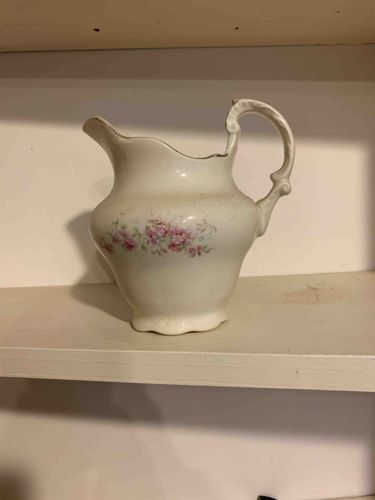
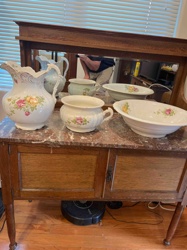
This is a small-to-medium-sized Victorian-style pitcher, likely intended for serving milk, cream, or water. It is constructed from white porcelain or fine semi-vitreous earthenware, featuring an elegant pear-shaped body that tapers to a scalloped, pedestal-style foot. The piece is decorated with a delicate pink and green floral transferware pattern, reminiscent of moss roses, wrapping around the mid-section. Notable features include a highly ornate, C-scroll handle with molded thumb rests and an asymmetric, ruffled rim. Gold gilt highlighting is visible along the rim and handle, though it shows significant signs of thinning and wear. The glaze exhibits 'peppering' or small dark inclusions, which are typical of late 19th to early 20th-century mass-production techniques. Regarding condition, there is a visible chip or loss at the top junction where the handle meets the rim, and another small chip is located on the pouring spout. The surface shows light crazing and scattered shelf wear on the base. While no maker's mark is visible in the photograph, the style and craftsmanship are consistent with American or English manufacturers from the 1890s-1910s, such as Homer Laughlin or various Staffordshire potteries.
AI-Generated Appraisal Disclaimer
Estimated Value
$45.00 - $65.00
Basic Information
Category
Antique Ceramics and Pottery
Appraised On
March 16, 2026
Estimated Value
$45.00 - $65.00
Item Description
This is a small-to-medium-sized Victorian-style pitcher, likely intended for serving milk, cream, or water. It is constructed from white porcelain or fine semi-vitreous earthenware, featuring an elegant pear-shaped body that tapers to a scalloped, pedestal-style foot. The piece is decorated with a delicate pink and green floral transferware pattern, reminiscent of moss roses, wrapping around the mid-section. Notable features include a highly ornate, C-scroll handle with molded thumb rests and an asymmetric, ruffled rim. Gold gilt highlighting is visible along the rim and handle, though it shows significant signs of thinning and wear. The glaze exhibits 'peppering' or small dark inclusions, which are typical of late 19th to early 20th-century mass-production techniques. Regarding condition, there is a visible chip or loss at the top junction where the handle meets the rim, and another small chip is located on the pouring spout. The surface shows light crazing and scattered shelf wear on the base. While no maker's mark is visible in the photograph, the style and craftsmanship are consistent with American or English manufacturers from the 1890s-1910s, such as Homer Laughlin or various Staffordshire potteries.
Related Tags
Explore similar items and categories:
Get Your Items Appraised
Instant estimates of your treasures with AI-powered instant appraisals